
Weekly Grounding #127
Special edition on China


Weekly Groundings are published every Friday to highlight the most interesting news, links, and writing I investigated during the past week. They are designed to ground your thinking in the midst of media overload and contribute to Handful of Earth’s broader framework. This week’s Grounding is a Special Edition on China. Please subscribe if you’d like to receive these posts directly in your inbox.
If you’re already subscribed and want to help the publication grow, you can share Handful of Earth with a friend or make a one-time donation to support my writing.
“China Is the World’s Sole Manufacturing Superpower: A Line Sketch of the Rise”
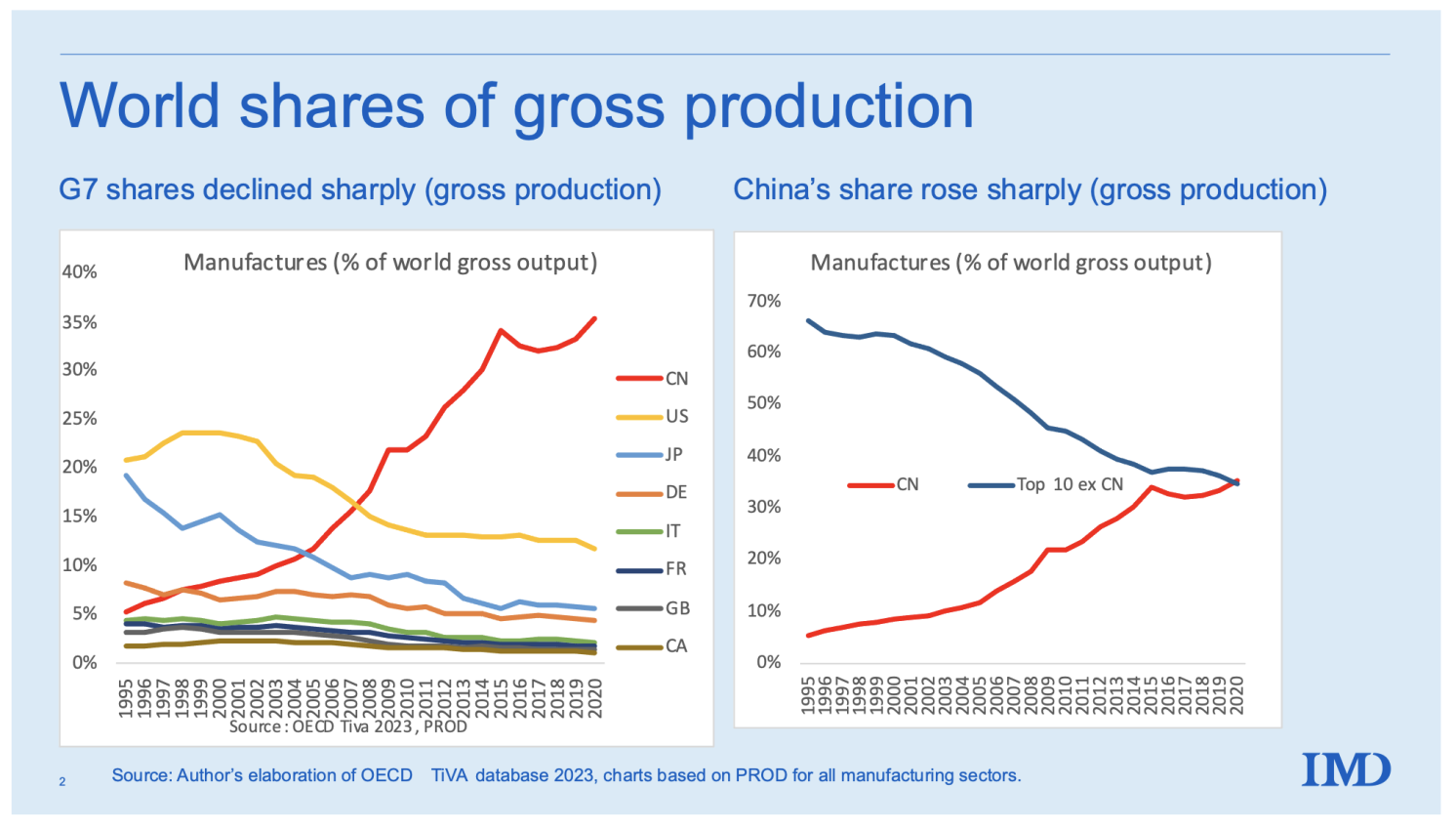
The Centre for Economic Policy Research’s Richard Baldwin argues that “China’s industrialisation is unprecedented. The last time the ‘king of the manufacturing hill’ got knocked off the throne was when the US surpassed the UK just before WW1. It took the US the better part of a century to rise to the top; the China-US switch took about 15 or 20 years. China’s industrialisation, in short, defies comparison.” China’s manufacturing rise since 1995 is indeed striking:
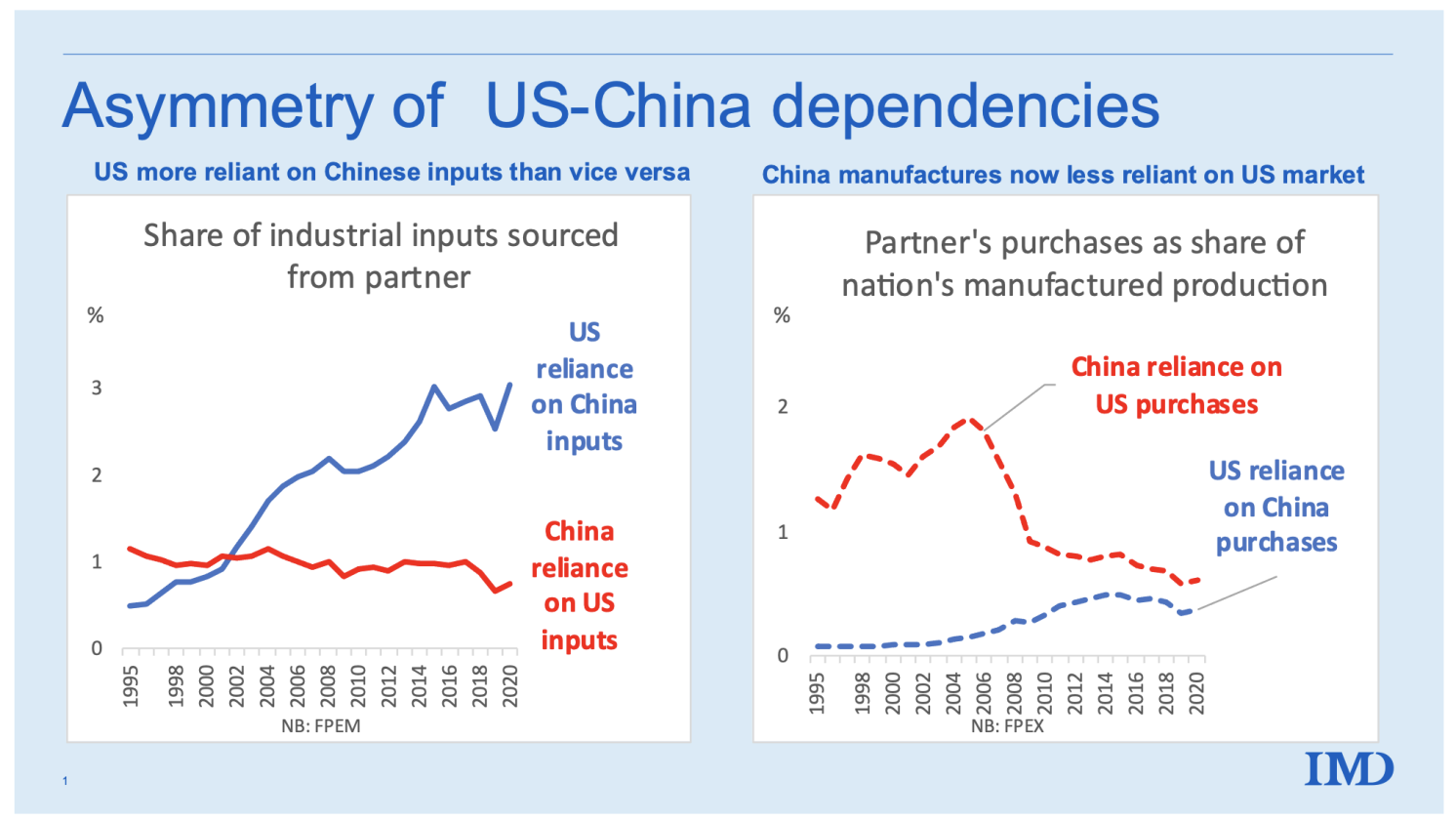
Baldwin notes that the “US relies far more on Chinese manufacturing production than vice versa. While shocking at first sight, this should not be unexpected. It is natural that a country with 11% of the world output buys more from a country that produces 35% than vice versa, but the numbers are astounding. China was more exposed to US inputs before 2002, but the US has had greater exposure since then. In 2020, the US was about three times more exposed to Chinese manufacturing production than vice versa.”
“The Makers of Modern China”
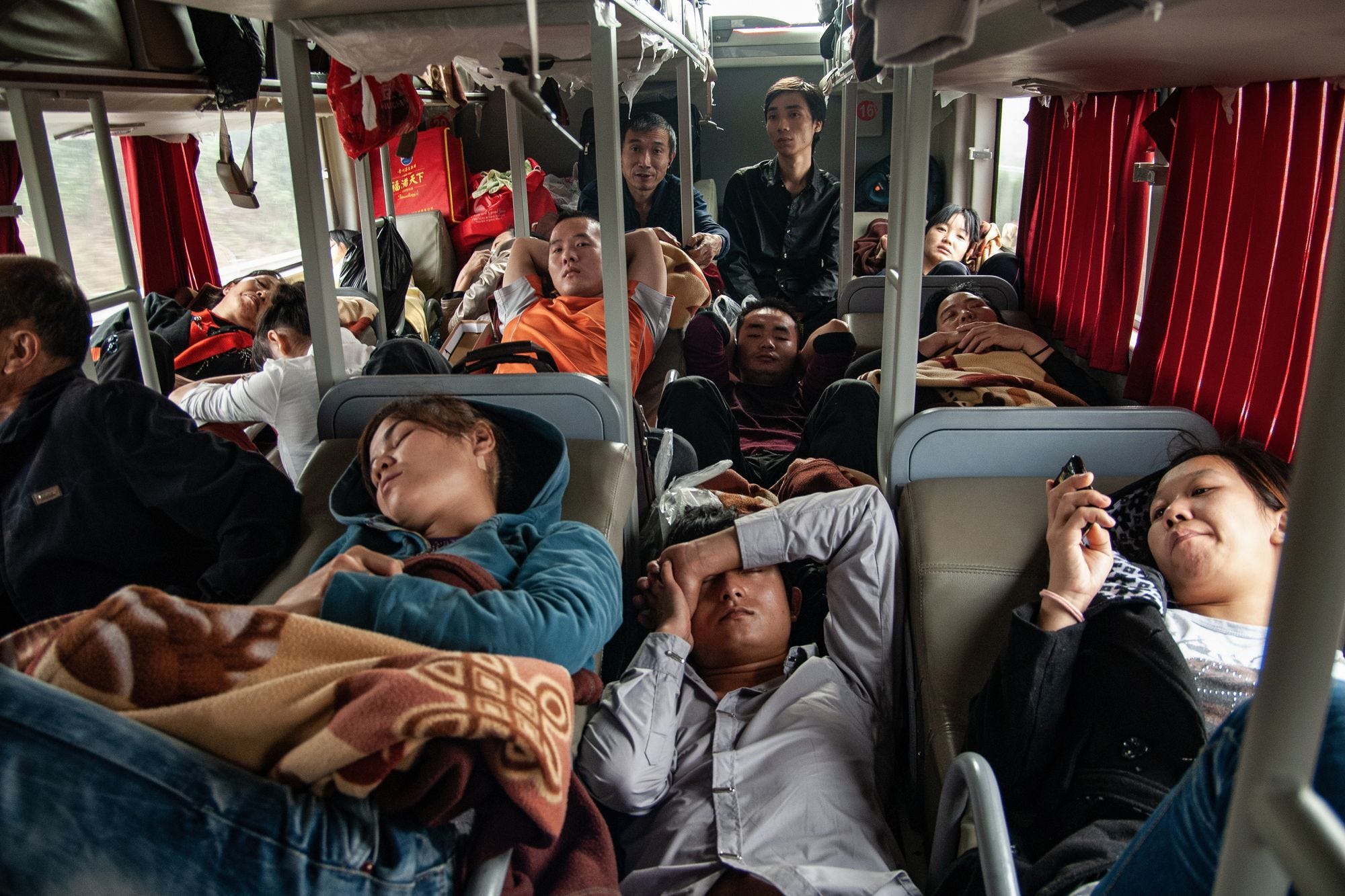
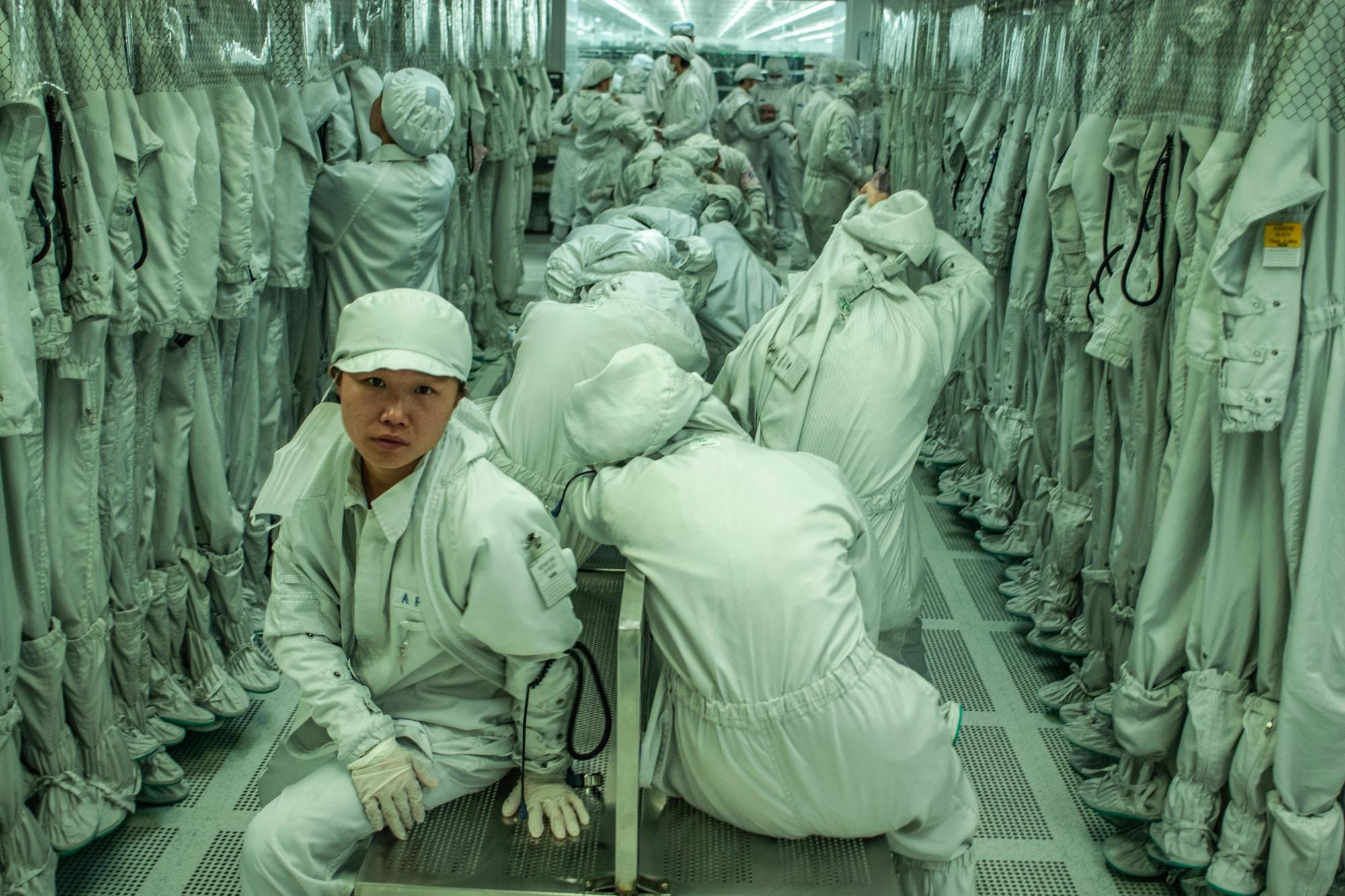
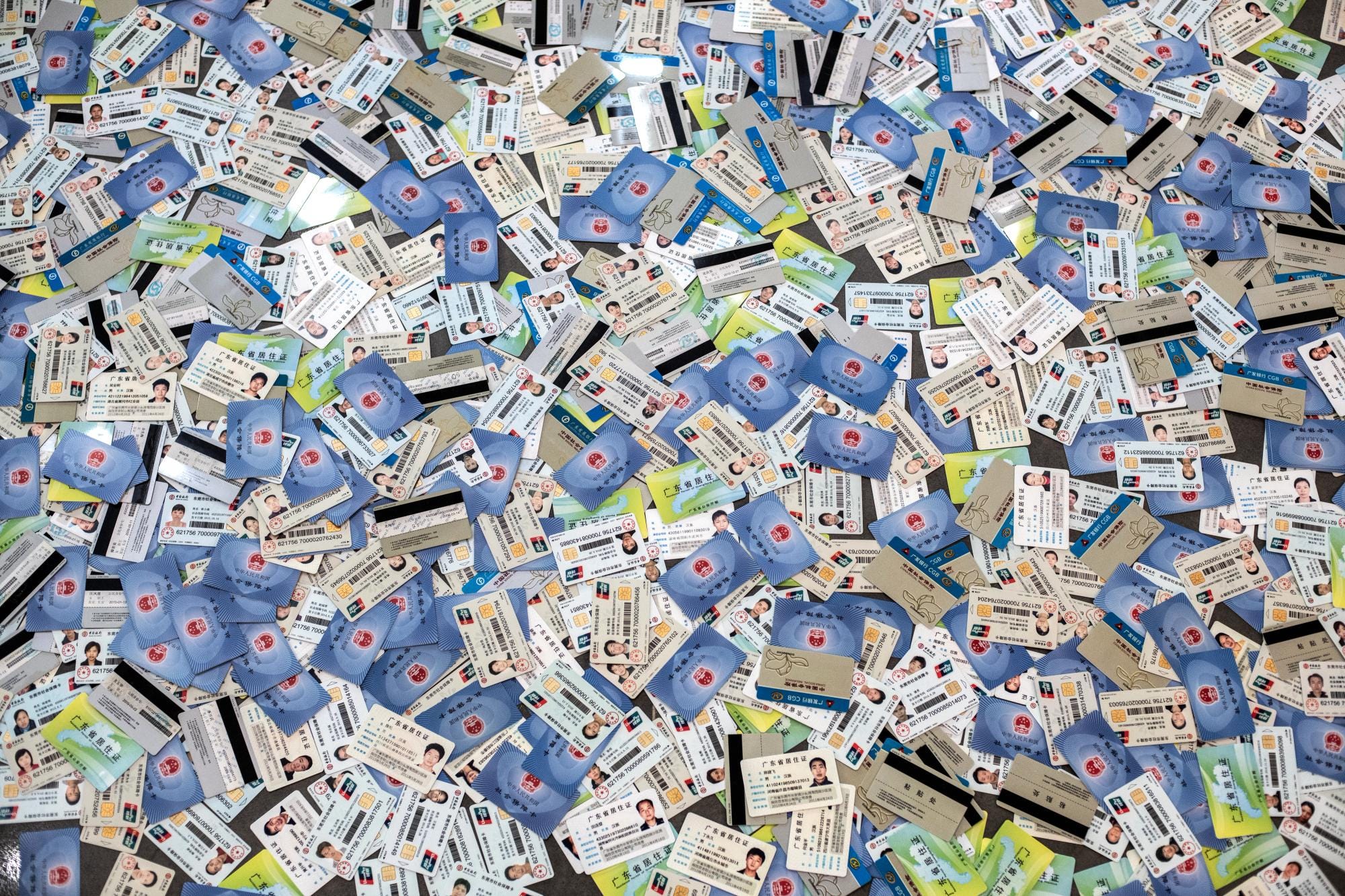
At Equator, Zheng Xiaoqiong tells the stories of the migrant workers whose labor lies behind China’s meteoric manufacturing rise. Excerpts from the stories don’t do justice to them, so I instead share some remarks from Kaiser Kuo’s introduction as well as photos with original captions from the piece.
“I first encountered Zheng Xiaoqiong’s writing in Iron Moon, a collection of Chinese worker poetry,” Kuo writes. “She restores dignity not through political theatrics, but through rigorous sensory detail: the clang of metal, the sting of dust, the smell of dirty socks, the fluorescent fatigue of factory nights, and cramped dormitories where shirtless men play cards and chainsmoke. She records the world as it is felt by the people who move through it. In doing so, she opens a space in which they can be seen as individuals—complicated, vulnerable and never reduced to symbols.”
Kuo continues: “These subjects are caught in a trap that has structured millions of lives over the past four decades. On one side lies the village: impoverished, agrarian and socially stifling. On the other lies the city: dazzling and modern, but also cold, precarious and brutally indifferent. Zheng’s writing captures the psychic tension of that in-between space—the feeling of being suspended between two worlds, belonging fully to neither. She resists both the standard, agency-stripping sweatshop narrative and the counternarrative of migrant labour as liberation from rural drudgery.”
“Zheng can do this because she has lived this life. For more than a decade, she was based in an ‘urban village’ outside Guangzhou—one of many such dense enclaves where migrant workers negotiate despair. She worked factory jobs, sleeping in those same dormitories. Between 2006 and 2015, she interviewed people in alleyways, restaurants and rented rooms, assembling a kind of oral history of the great migration to Guangdong. The resulting manuscript, Woman Worker, edged close to citizen journalism—a perilous vocation in contemporary China. Much of the text was considered too sensitive domestically, and Zheng has refused to accept the extensive redactions that some would-be publishers have demanded. So the book has never been published.”
“The Chinese Billionaires Having Dozens of U.S.-Born Babies Via Surrogate”
The Wall Street Journal reports on the “little-known trend in the largely unregulated U.S. surrogacy industry: Chinese elites and billionaires who are going outside of China, where domestic surrogacy is illegal, to quietly have large numbers of U.S.-born babies.”
“The market has grown so sophisticated, experts say, that at times Chinese parents have had U.S.-born children without stepping foot in the country. A thriving mini-industry of American surrogacy agencies, law firms, clinics, delivery agencies and nanny services—even to pick up the newborns from hospitals—has risen to accommodate the demand, permitting parents to ship their genetic material abroad and get a baby delivered back, at a cost of up to $200,000 per child.”
“Some Chinese parents, inspired by Elon Musk’s 14 known children, pay millions in surrogacy fees to hire women in the U.S. to help them build families of jaw-dropping size,” the Journal reports. Video game mogul Bo Xu “calls himself ‘China’s first father’ and is known in China as a vocal critic of feminism. On social media, his company said he has more than 100 children born through surrogacy in the U.S…Last month, Xu’s ex-girlfriend, Tang Jing, alleged in a post on Weibo that he had 300 children, living across numerous properties in multiple countries. Xu has previously accused Tang of theft and the two have ongoing lawsuits. Tang didn’t respond to requests for comment. In a statement on Weibo at the time, Duoyi Network said the 300 figure was wrong but confirmed a stunning fact: ‘After many years of effort’ through surrogacy in the U.S., Xu has ‘only a little over 100’ children.”
“How Capitalism Replaced America”
Murtaza Hussain compares the relationship between capital and citizenship in China and the United States at his eponymous Substack. “The crucial difference is that while China utilized capitalism as a tool, it never redefined its national identity around the supremacy of capital. The Communist Party remains the unchallenged sovereign. However wealthy or powerful a Chinese enterprise becomes, there is no conceptual universe in which it might negotiate as equals with, let alone defy, the Party. No Chinese banker could dream of strolling into the Zhongnanhai to lecture Xi Jinping, as American financiers feel free to lecture or even snub American presidents.”
Hussain writes that, since the 1970s, “vast swathes of the economy were sold off to international investors. Immigration levels were reshaped by corporate demand rather than cultural self-conception. Even stewardship of land and future generations became subordinated to the interests of global markets. At mid-twentieth century, foreign investors held only around 5 percent of U.S. corporate equity. That figure is 40 percent today, alongside massive and expanding international ownership of U.S. real estate, and even agriculture.
The supremacy of capital was on display again recently in a particular episode: the proposed takeover of Warner Bros Discovery by Paramount Skydance. The takeover is backed by a consortium of Saudi, Emirati, and Qatari sovereign wealth funds, Jared Kushner’s investment firm, and the Ellison family—the latter being figures with deep personal, political, and economic ties to the state of Israel. If completed, the deal would finalize control over vast pillars of American mass culture—HBO, CNN, Paramount Pictures, CBS, DC Films, Nickelodeon, and now TikTok—within a network of capital holders largely foreign to the United States, or with shared sympathies to other states.”
“According to the logic of modern American capitalism, nothing is wrong with this,” Hussain writes. “But if the deal goes through it would reduce even further national control over institutions central to American culture and governance. The American media would be penetrated to an unprecedented extent by foreign interests, in this case Gulf Arab and Israeli. It is impossible to imagine China permitting anything remotely comparable with their own media, which closely shepherds not just the interests of the Party or Chinese citizens, but even the cultural and political centrality of the domestic Han majority.
“This oligarchic media consolidation by foreign investors is a step further in a decades-long transformation. The idea that the US should be run mainly for the sake of its citizens—let alone, as some demand, in reference to its original European, Native American, and Black lineages—has been displaced by the idea that the country is a platform for global capitalism. It helps explains why elites like Kushner admire the glittering, frictionless, deracinated consumerism of the UAE and other Gulf Arab states. Dubai represents a post-national, antidemocratic future, optimized only for wealth, that many people find desirable for the US itself.”
“The Repetition of China”
At Made in China Journal, Alex Taek-Gwang Lee argues that “Global capitalism, in its current incorporated form, would not have been possible without China. Far from existing on the margins of capitalist modernity, China has functioned as its engine room: the site where global value chains are materialised, where the abstractions of finance find concrete form through labour, logistics, and infrastructure. Since the late twentieth century, China’s consolidation into the world economy has represented not a deviation from capitalism’s logic, but rather its radical amplification. The unprecedented scale, speed, and precision of contemporary capital accumulation rely on the productive and administrative capacities that China has developed within its unique model of state–market integration.
“In this context, we should treat the ongoing discourse of ‘decoupling’ between China and the United States with caution. It does not signify a rupture between two distinct systems, but rather a readjustment within an interdependent architecture…China and the United States are no longer geopolitical rivals in the classical sense; they are co-architects of a planetary dispositif, the operations of which depend not on liberal-democratic values but on predictive data, algorithmic governance, and logistical scalability.”
“In this light,” Lee elaborates, “China does not stand as a new or alternative civilisational model. Instead, it represents the most refined instantiation of Western capitalism to date. It has absorbed the core logic of European modernity—that is, rationalisation, secularisation, and accumulation—and fused it with a centralised cybernetic system of governance. What distinguishes the Chinese model is not its rejection of class contradictions but its capacity to modulate, manage, and contain them within a tightly integrated apparatus of state power, technological infrastructure, and ideological scripting. Class antagonisms are not abolished; they are rendered legible and governable through real-time data feedback, social credit systems, and algorithmic surveillance. The Chinese State has thus operationalised the contradictions that liberal democracies continue to displace into political crisis.”
He continues: “The mirror that China now holds up to the world reveals something the West prefers to forget: that this model was born not in Beijing, but in the fusion of capitalist accumulation, colonial logistics, and Enlightenment rationalisation that shaped the modern world system. From Nixon’s rapprochement to the decades of offshored manufacturing and financial interdependence that followed, Western capital abetted the very developmental path it now condemns as ‘authoritarian capitalism.’ What it denounces in China is, in truth, the stripped-down image of its own historical project, a rationalised, technologised order in which development displaces politics as the organising principle. The world that now disquiets the West is not alien but a perfected continuation of the one it built and exported, and which it no longer dares to recognise as its own creation.”
“China, India and the Cosmology of Civilizational Renewal”
In contrast with Lee’s perspective, Jan Krikke argues that China provides an alternative civilizational model to the “dominant Western imagination of history as a linear project of individual achievement and advancement.” In his article at Asia Times, he writes that “Chinese thought anchors ethics in the relational networks, ritual propriety, and social harmony of the present world. In contemporary China, echoes of this ancient idea persist in the government’s emphasis on harmonious governance, social stability, and adaptive leadership as proof of its ongoing mandate. It reinforces the civilizational revival by linking modern governance to ancient cosmological principles.”
Krikke suggests that a civilizational “sense of continuity remains alive in India and China today. The resurgent confidence of both countries has an economic and political dimension; it is civilizational in character. It reflects a conscious effort to anchor modern development, power, and identity in older understandings of cosmic order and moral purpose…As both countries assume a larger role in shaping the 21st-century world, their cosmological traditions are likely to influence how they approach shared global challenges. Their cosmologies do not function as policy doctrines, but as quiet assumptions about ethics, responsibility, and humanity’s place in a larger order.”
What grounded your thinking this week? Share in the comments.
And the global capitalist crisis is not sparing China either, not at all. From my newsletter of 2 days ago.
he economic data from China are DISMAL. Exports being dumped on world markets are the only thing preventing an outright crash.
https://www.youtube.com/watch?v=eC7-lUKaiSE
HOLY SH*t! China's Economy is COLLAPSING. Jeff Snider/Eurodollar University, 1/19/26, 22 minutes.
"Chinese retail sales just did something they’ve never done before outside of the lockdowns. At the same time, capital investment continues to legitimately crash, December was third month in a row of steep declines leading to the first yearly negative for it in China’s modern history. The only thing, the ONLY thing, keeping the economy from completely falling off a cliff is China selling everything it can everywhere else, especially in Europe.”