
Weekly Grounding #138
News, links, writing


Weekly Groundings are published every Friday to highlight the most interesting news, links, and writing I investigated during the past week. They are designed to ground your thinking in the midst of media overload and contribute to Handful of Earth’s broader framework. Please subscribe if you’d like to receive these posts directly in your inbox.
If you’re already subscribed and want to help the publication grow, you can share Handful of Earth with a friend or make a one-time donation to support my writing.
“The SPLC’s Racism Industrial Complex”
At her eponymous Substack, Mary Harrington writes: “So it turns out that the racism industrial complex might have been a self-licking ice cream cone all along. The Southern Poverty Law Center, once a renowned and respected civil rights advocacy group, has been charged by the US government with manufacturing Right-wing false flag operations Kash Patel, director of the FBI, yesterday announced a ‘massive, sweeping indictment’ of the SPLC, for fraud.”
“Patel alleges that the SPLC raised money from donors, claiming it would be spent on efforts to dismantle violent extremist groups,” she reports. “But instead, they used that money to pay the leadership of the groups they were purportedly combating. Groups alleged to have been funded included the Klu Klux Klan, Unite the Right (the group linked to the Charlottesville terrorist attack against counter-protesters), the National Socialist Movement, and the Aryan Movement biker group. The federal charges allege that over $3m was used not to combat Right-wing extremism, but to fund further extremist crimes, in a scheme that Patel says ran for over a decade through shell companies and other entities.”
Harrington continues: “Perhaps once social activism is professionalised, these kinds of perverse incentives are unavoidable. After all, if my income depends on there being a supply of homeless people to rescue, or racism to combat, it’s not really in my interests for these social ills to be eliminated. This kind of moral market-making is a close cousin of the post-liberal scourge of “policy laundering”, in which activist charities and international bodies are used at one remove by governments as lobbyists for policies government itself wants to pursue. Like policy laundering, moral market-making contributes to the pervasive modern-day suspicion that the framework to which public life is ordered has come wildly adrift from common-sense policy on the ground, in ways that are difficult to identify and thus impossible to challenge.”
“Even so, the SPLC’s alleged, decade-long, fraudulent cultivation of a seemingly largely synthetic ‘far right’ threat, variously to justify their own existence or to smear other more mainstream political opponents, has to rank as one of the most cynical, toxic, and morally bankrupt pieces of sustained political theatre I’ve ever come across…If the allegations are proven, those smeared might legitimately feel that some retribution is in order.” This is, of course, a big “if” since Patel and the Trump administration are hardly good faith actors. But the fact that the SPLC, which Harrington correctly describes as “an organisation that has clearly long since lost any semblance of integrity,” is under scrutiny is a significant development.
“Pan Africanists, SPLC & The Policing of Political Boundaries”
Addressing the SPLC from another angle, Yvette Carnell argues that an “organization that built its reputation policing extremism has quietly evolved into something far more consequential: a gatekeeper of acceptable Black politics. It no longer functions solely as a watchdog identifying hate, but as an institution with enough media credibility to shape which movements are legitimized and which are sidelined. When it turned its attention to ADOS [American Descendants of Slaves]—through its framing of my association with the Project for Immigration Reform (PFIR) and the narrative machinery of SPLC’s Hatewatch—it did not simply critique ideas. It drew a boundary. A boundary that effectively says you are free to speak, but only within parameters we sanction. Step outside those lines, and you are no longer engaged—you are disqualified.”
“What makes this mechanism especially effective is how Hatewatch operates,” Carnell explains. “It does not function as a neutral newsroom, but as a signaling system. After SPLC accuses an organization of being a hate group, the framing is established through carefully selected language, strategic associations, and just enough insinuation to raise suspicion without the burden of proof, and then that framing spreads like a plague. Journalists cite it. Activists echo it. Social media distills it into shorthand. Over time, the label sticks. And because it originates from the SPLC, it carries a pre-approved legitimacy that discourages scrutiny.”
“From…[its] elevated and financially dominant, media-validated, and largely unaccountable perch, the SPLC directed its attention toward an emerging, grassroots ADOS movement. And it did not act alone. It was aided by Black activists who, while professing commitments to Black unity and reparations, adopted and amplified a framework that foreclosed debate rather than engaging it. That is the deeper issue here. This is not simply disagreement. It is the weaponization of white institutional credibility by Pan-African activists to determine which Black political projects are allowed to exist within the bounds of legitimacy—and which must be marked, managed, and ultimately marginalized. How can ADOS movement leaders ever be expected to trust the Pan Africanist organizers who attempted to use a white organization to destroy our project? If that’s what Black unity looks like, I want no part of it.”
“Meet the Top ‘Content’ Producers Linked to Canary Mission”
At Drop Site News, Jacqueline Sweet reports: “The pro-Israel doxxing site Canary Mission has been notoriously secretive since its creation in 2015. The anonymous website, which began as an online blacklist targeting academics and activists who expressed pro-Palestine views, over the last year has been used by the Trump administration to select international students for arrest, detention, and deportation. Despite its increasingly high profile, the website’s operators have remained largely unknown.”
She writes that, “In January, Drop Site reported on unlisted websites used by Canary Mission to plan and execute its doxxing operation and was able to confirm that the site is operated in Israel. The unlisted website data revealed that an employee paid by the Israeli nonprofit Megamot Shalom as a writer provided content for Canary Mission’s dossiers of targets, confirming earlier reporting by The Forward that Megamot Shalom’s only known activity appears to be providing support to Canary Mission.”
“Drop Site has now identified five more people whom Megamot Shalom has employed as content writers, editors, and consultants,” Sweet continues. “These individuals—Elihu David Stone, Yehuda HaKohen, Abigail Bornstein, Aharon Dikel, and Alexander Malbin Duncan—were identified through a review of Megamot Shalom’s business filings with the Israeli government from 2016 to 2024, where they were listed as the nonprofit’s highest-paid employees. They are all Americans who moved to Israel and are connected to one another and individuals reported to be involved with Canary Mission.”
She notes that “The American Israelis who appear to be providing content for Canary Mission’s operations via Megamot Shalom come from all over the U.S., and have been involved in American organizations like settler nonprofits, the Wexner Foundation, and Israeli groups with reported ties to the Israeli government such as the legal nonprofit Shurat HaDin…Canary Mission’s dossiers were used by the Department of Homeland Security in 2025 to build lists of foreign students who expressed pro-Palestine views, with over 75 people identified based on Canary Mission’s anonymous blacklists, according to deposition testimony by DHS officials in a federal lawsuit filed by the American Association of University Professors and the Middle East Studies Association. In January, a federal judge ruled in favor of the plaintiffs and said the case revealed an ‘unconstitutional conspiracy’ to violate the First Amendment.”
“The Christian Villages Under Israeli Occupation in Lebanon”
The Financial Times reports that “roughly 10,000 residents of a handful of Christian villages along Lebanon’s southern border…[are] now trapped within Israel’s so-called security zone, surrounded by Israeli soldiers in what locals fear is an indefinite occupation. The zone spans hundreds of square kilometres and extends up to 10km into Lebanese territory. It encompasses dozens of mostly depopulated Shia Muslim villages, where Israel’s military was locked in fierce conflict with Hizbollah militants for weeks before a fragile US-brokered ceasefire on April 16 brought the worst of the fighting to a halt.”
“Lying below what the Israel Defense Forces have taken to calling the ‘yellow line,’ which marks the start of Lebanese territory newly occupied by Israel, these villages are now cut off from the rest of the country. They say they have been abandoned by the state and are sustained almost exclusively by Christian aid groups that co-ordinate with the UN to periodically drop off vital supplies when permitted by the IDF…While a few hundred people left the villages after Israel issued mass evacuation orders at the start of the latest war, only those with urgent medical needs are now allowed out, residents, aid groups and local officials said.”
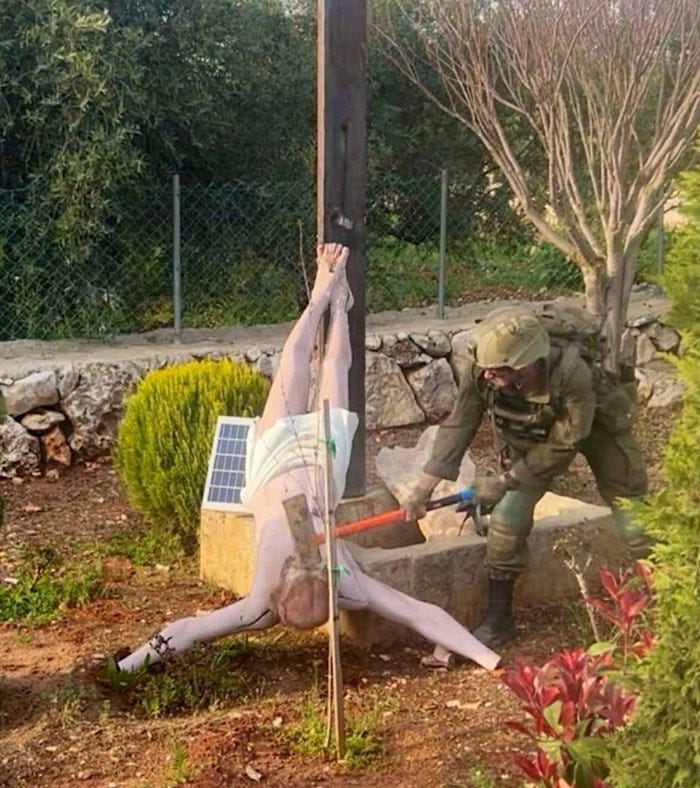
“Throughout the day, the FT heard Israeli drones, artillery and large blasts—thought to be demolitions—in nearby villages. ‘Every time we hear a blast, our hearts break a little, knowing they’re erasing part of our neighbours’ history,’” one resident stated. “Three local Christian men were killed by Israeli troops last month while repairing a satellite dish on the roof of a house, Lebanese authorities and residents said. The IDF claimed it had attacked Hizbollah operatives ‘attempting to install surveillance equipment on a rooftop.’…An IDF soldier was pictured smashing a statue of Jesus in Debel, one of the Christian villages, provoking outrage. A subsequent aid delivery to Rmeish from Israel prompted its own backlash. And the remaining residents of the Christian villages have been branded as collaborators by Hizbollah supporters for their mere proximity to Israeli forces.”
“A Brief History of Techno-Negativity”
Thomas Dekeyser offers a “whirlwind look at how people and communities have rejected, shunned, or refused technology through history, and why their techno-negativity matters more than you think” for Brian Merchant’s Blood in the Machine.
A couple of Dekeyser’s examples deserve special mention: In Ancient Greece, “the expansion of scientific knowledge at the time failed to translate into a corresponding burst of technological invention. The era was overwhelmed by a deep suspicion in the face of techne. To give just one example, the philosopher Archimedes, a crucial inventor of various technical devices and machines, was also the world’s first machine breaker, destroying his own machines in the hope of staving off future use.”
In the 1980s, “Militant groups around the European continent—including the Italian Red Brigades, German Red Army Faction, and Belgian Communist Combatant Cells—set fire to the companies and infrastructures fueling the arrival of computers. A French group with the fantastic name Committee for the Liquidation or Subversion of Computers (C.L.O.D.O. in French) is amongst the most prominent of that era. Between 1980 and 1983, they set arson to or bombed at least 12 computer companies. Late at night, they would sneak into offices of firms like Philips Data Centre and Honeywell, gather computers and magnetic tapes, set fire to them in the toilets, and flee before the police arrived. Their target was less tech’s displacement of labor (Luddites) or its general impoverization of life (MOVE), and instead computation’s enrollment into the state apparatus as a war machine and a technology of surveillance. Computers, they argued before the arrival of the ‘personal computer’, would bring dominance as much as emancipation.”
Dekeyser concludes: “The messiness of technological advancement shows those of us keen on altering our current technological predicament that there are gaps everywhere that can be cracked open further. The current path of technologization is neither inevitable nor natural. Evangelists in corporations or governments may like to tell us it is as a way of undermining our sense of collective agency, but together with the infinite cast who make up the history of techno-negativity, we know better. At a time when Big Tech is becoming enamored with authoritarian politics, the stakes are higher than ever. What are the vulnerabilities or cracks in our AI-obsessed moment that can be exploited? We can turn to radical movements from the past not for blueprints, but for initial inspiration. The point is not to try and turn back the time, but to realize a technological refusal adequate to our increasingly dark present.”
You Will Eat the Bugs
At Social Studies, Leighton Woodhouse writes: “When the moment of reckoning finally arrives, when the tidal wave of job loss from artificial intelligence has submerged every household in the country, when, no matter how hard we squint, we can barely discern a future for our children anymore, we will turn, in panic, to the government for relief. All the policy ideas for managing the crisis that sound so radical today—Universal Basic Income, treating AI like a public utility—will appear, in that moment, hopelessly meek. Facing annihilation, we will seek acts of heroism from the state commensurate to the scale of the emergency. But by then, it will be too late. Whatever is left of what we know now as ‘government’ will no longer respond to our needs. In a world in which humans play no productive role in the economy, our interests will have no relevance to the state. The only interests that will register to it will be those of the oligarchs.”
He continues: “A paper titled The Intelligence Curse…compares the future before us to the circumstances of people living in countries with abundant natural resources. Take the Democratic Republic of the Congo, for example. The DRC is the richest country in the world measured in its trillions of dollars of extractable minerals, yet one of its poorest in terms of human welfare. The government of the DRC is flush with wealth from foreign companies—now primarily Chinese—that purchase leases to mine the country’s cobalt, a critical mineral for rechargeable batteries. There is no incentive for the government to invest in education, urban infrastructure, or decent housing for the vast majority of its citizens, because the state’s fiscal health does not depend on taxing a prosperous citizenry, and the poverty of the Congolese provides foreign investors with cheap labor. The results are predictable: mass poverty, rule by oligarchs, tyranny.”
“The paper’s authors expect the same to happen in an A.I.-dominated economy in which wealth is overwhelmingly produced by machines and not by humans,” Woodhouse writes. “Why would the state, in such a world, continue to recognize such things as the civil liberties and personal property rights of a human population with no value to it? Why would it make concessions to those dispossessed of all bargaining power? Why would it regard us any differently than we regard the fish of the ocean?”
He concludes: “Democracy is not just a set of values. It’s a social structure that rests on certain economic conditions—conditions that are not long for this world. Training ethical values into LLMs will do nothing to address this transformation. We will not prosper in a world of benevolent dictators, whether machine or human. As the economic value of human labor declines, our social value, in the eyes of the state, will decline accordingly. We are creating a successor society in which we have no future.”
What grounded your thinking this week? Share in the comments.