
Weekly Grounding #139
Americans abroad; student debt; Chinese AI; vaccine mandates; dropping out


Weekly Groundings are published every Friday to highlight the most interesting news, links, and writing I investigated during the past week. They are designed to ground your thinking in the midst of media overload and contribute to Handful of Earth’s broader framework. Please subscribe if you’d like to receive these posts directly in your inbox.
If you’re already subscribed and want to help the publication grow, you can share Handful of Earth with a friend or make a one-time donation to support my writing.
“Americans Are Leaving the U.S. in Record Numbers”
The Wall Street Journal reports that “Last year the U.S. experienced something that hasn’t definitively occurred since the Great Depression: More people moved out than moved in. The Trump administration has hailed the exodus—negative net migration—as the fulfillment of its promise to ramp up deportations and restrict new visas. Beneath the stormy optics of that immigration crackdown, however, lies a less-noticed reversal: America’s own citizens are leaving in record numbers, replanting themselves and their families in lands they find more affordable and safe.”
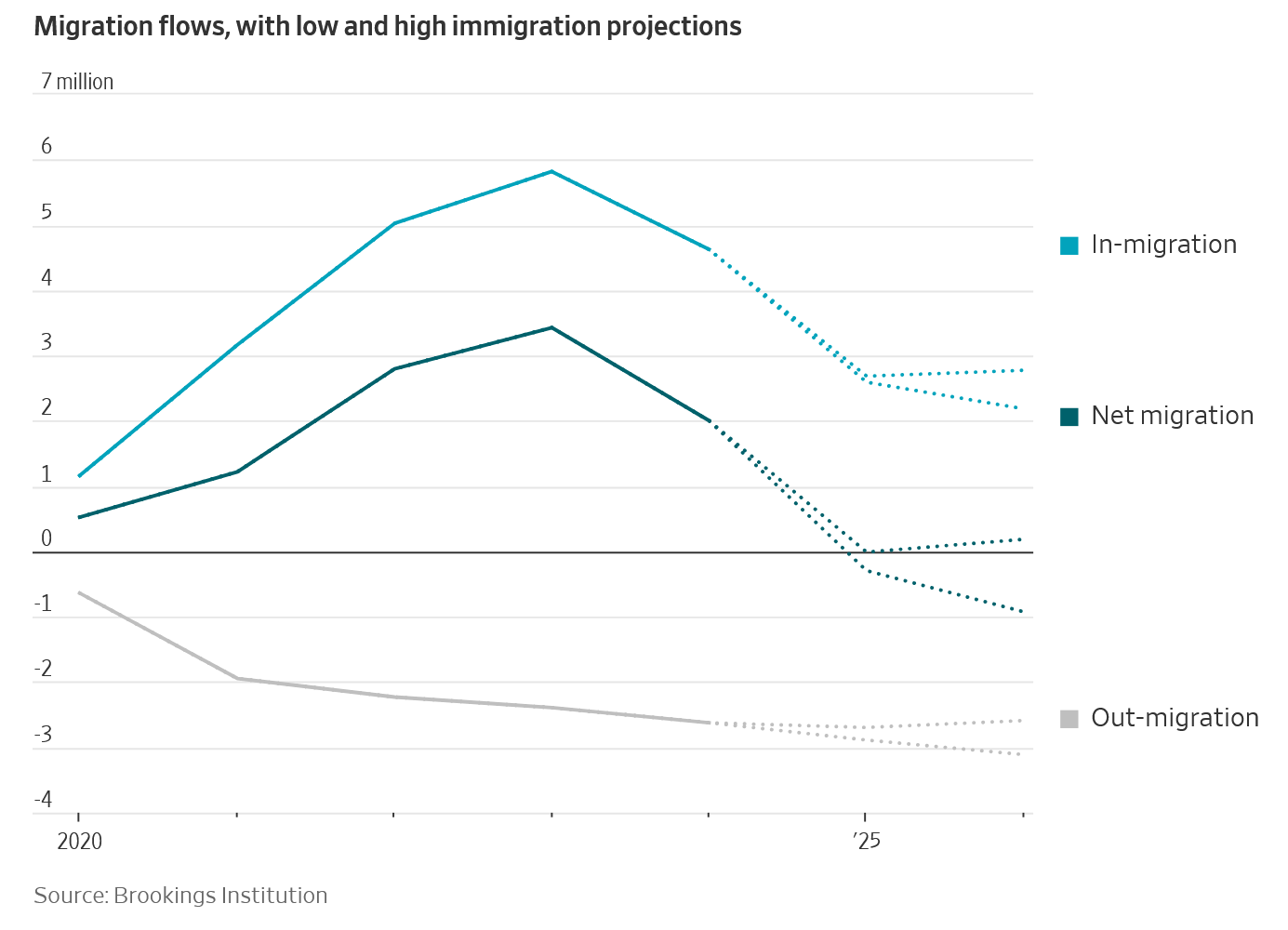
The article continues: “In the cobblestoned streets of Lisbon, so many Americans are snapping up apartments that the newest arrivals complain they mostly hear their own language—not Portuguese. One of every 15 residents in Dublin’s trendy Grand Canal Dock district was born in the U.S., according to realtors, higher than the percentage of Americans born in Ireland during the 19th-century influx following the Potato Famine. In Bali, Colombia and Thailand, the strains of housing American remote workers paid in dollars have inspired locals to mount protests against a wave of gentrification. More than 100,000 young students are enrolled abroad for a more affordable university degree. In nursing homes mushrooming across the Mexican border, elderly Americans are turning up for low-cost care.”
“The booming number of new relocation companies say they’re struggling to keep up with demand,” the Journal reports. “They include LuxNomads for the well-to-do; GTFO Tours, attracting Trump critics; Blaxit Global, for Black Americans, and SheHitRefresh, for the biggest boom market of all, women. A Gallup poll last year found 40% of American women, ages 15-44, would like to permanently move overseas, if possible. By comparison, in 2023, the same pollster found that a slightly smaller proportion of sub-Saharan Africans—37%—wished to do the same.”
“Student Debt Burdened Them, So They Moved Abroad and Stopped Paying”
Other Americans have moved abroad to avoid paying back crippling loans, The New York Times reports: “More than 40 million borrowers are saddled with federal student debt, and a record number—7.7 million—have defaulted on their loans, according to recently released data from the Education Department. For some borrowers, moving abroad and out of reach of debt collectors can be tempting. In interviews, people who made this decision cited relieving the psychological burden of student debt as a motivator, as well as having a higher quality of life, even on a lower salary, outside the United States. Many who fled abroad…said they had no plans of ever returning.”
“In 2016, Eric Cooper graduated from a state school in Georgia with a degree in logistics. He received good grades and found a job as a logistics manager earning $52,000 a year almost immediately. But he had $80,000 of student debt…Mr. Cooper’s payments were over $600 a month, and he was living paycheck to paycheck. He considered his options and planned to default not long after graduating, realizing his debt would take decades to pay off…After working for three years and making timely payments, he refinanced the loan into his name with a private lender. Within months, he moved to Southeast Asia to teach English and continued making minimum payments while applying for citizenship in his new country. He stopped paying when it was secured. Mr. Cooper defaulted on his loans in 2019, changing his email and phone number, never alerting debtors to his new address.”
One analyst of this growing trend “said she was concerned about the narrative that defaulted borrowers living abroad were ‘gaming the system,’ or being such a small minority of borrowers that their experiences shouldn’t motivate policy change. ‘This is one piece of the bigger puzzle of how borrowers are managing,’ she said. ‘The fact that someone would need to make such a drastic life change driven by student debt is, itself, an indictment of a broken system.’”
“When Will Americans Take the Blame?”
With more and more Americans abroad in the midst of the Iran War, Rana Foroohar writes at The Financial Times: “I’ve been wondering for some time when the rest of the world would begin to take its understandable frustration over this administration—which has turned the best post-Covid recovery in the world into an economic attack on self and other—out on Americans themselves. I was in Italy a couple of weeks ago and got an earful from a jewellery shopkeeper who was furious that the war in Iran was not only dampening her business in the present but making it impossible to plan for the future. ‘Why does your president have to change his mind every day?’ She shouted at me. I wish I knew…”
She continues: “I was also struck by a recent survey showing that seven in 10 US travellers abroad were facing hostility thanks to the politics and economics we are exporting. While many prime destinations in Europe depend on US tourists—and property buyers—I wouldn’t be surprised to see more of a pushback (visa restrictions? Limits on expats buying second homes?) if there’s a perception that wealthy Americans are making it (even) harder to live day to day, not only because of the Iran energy shock but because the asset wealth created in the US in recent years is so disproportionate.”
“I Went to China to See Its Progress on A.I. We Can’t Beat It.”
In a guest op-ed at The New York Times, Sebastian Mallaby writes that “China’s tech sector is too sophisticated to be stopped from building powerful A.I. In pursuing an impossible objective, the United States is missing an opportunity to try for one that sounds fanciful but which, after a recent reporting trip to China, I believe is more realistic: America should negotiate with China a global pact on A.I. safety, which would impose universal limits on a technology that can do much good—but, in the wrong hands, would do much harm.”
“China has rolled out a series of excellent A.I. models,” he continues. “China’s ability to skirt U.S. controls will not change, even if the Senate follows the House in passing a bill to restrict China’s access to outside data centers. China is learning how to do without cutting-edge chips by stacking less powerful chips together. Its model builders also take full advantage of a process known as distillation. Every time a U.S. lab produces a cutting-edge model, Chinese rivals quickly reverse-engineer its capabilities and build a copycat version. The follower has the advantage.”
“The upshot is that China and the United States are roughly level in the A.I. contest,” Mallaby writes. “Top Chinese models may be a few months behind American ones, and the relative position on military applications is difficult to ascertain as so much is classified. But on industrial applications, China seems to be leading. U.S.-sanctioned companies such as Huawei and Hikvision are rolling out A.I. systems that perform maintenance checks on high-speed trains, manage mining operations and scan water samples to assess pollution. At Huawei’s campus near Shenzhen, I recently took a ride in an autonomous car. A device in the passenger seat massaged my back, and the steering was immaculate.”
He concludes: “For now, China’s instinct to race for powerful A.I. overwhelms any caution. This is a rational response to a U.S. administration that is equally determined to put speed ahead of safety. But if a U.S. leader went to China and offered to scrap chip controls in exchange for collaboration on A.I. nonproliferation, there would be at least some chance of the proposal succeeding.”
“US vs China: Two Armies, Two Theories of the Body”
At Asia Times, Y Tony Yang reports: “In the same week that China’s People’s Liberation Army quietly continued its annual mass immunization drills, US Defense Secretary Pete Hegseth announced that American service members would no longer be required to receive the flu vaccine—a break from a practice in place almost continuously since 1945.”
“On the surface, this looks like a narrow administrative tweak,” he continues. “Read against the Chinese approach, it is something larger: a philosophical split over where the individual soldier ends and the collective instrument of national power begins. The new US policy, signed April 21, makes the seasonal flu shot voluntary for all active and reserve personnel and Defense Department civilians, while retaining mandates for measles, mumps, polio and other diseases. The stated rationale is ‘medical autonomy’ and religious freedom. The PLA, by contrast, treats routine immunization as an unremarkable extension of force-health protection—closer in logic to physical fitness testing than to personal medical decision-making.
Yang concludes: “A flu shot is a trivial medical event. The policy around it is not. It encodes how a state understands the relationship between the individual and the mission, between conscience and cohesion, between freedom and force.”
“Chinese Spy Agency Warns Nation’s Young People Against Dropping Out”
The Financial Times reports that “While some young workers are optimistic about China’s prospects in cutting-edge sectors such as AI and robotics, a years-long property slump has hit economic growth, while cut-throat competition and falling profits have left many feeling burnt out and fed up. Some young people are choosing to move back home to live with their parents or to live in cheaper rural areas. There, they take up informal gig work or drop out of the workforce entirely to live on savings.”

In response to this trend, “The Ministry of State Security, the country’s spy agency, this week said foreign forces were seeking to ‘erode the minds of Chinese youths’ by disseminating anti-work propaganda online, encouraging them to drop out or, in Chinese internet parlance, ‘lie flat.’...In its warning, the MSS said it discovered multiple overseas organisations that had funded anti-China media outlets, think-tanks and influencers that had peddled narratives such as ‘lying flat is justice’ and ‘struggle = exploitation.’”
“For Wu Chouchou, 34, who this week left Shanghai after 10 years of working and returned to her home village in Anhui province, the reasons for her malaise were more prosaic,” the FT reports. “‘I’ve probably reached a point of burnout. I don’t want to keep doing this kind of work that’s neither valuable nor interesting,’ said Chouchou, who asked to be identified by a pseudonym. She plans to take up farming in Anhui and is open to exploring other ways to make a living. There was nothing negative about this, Chouchou added. ‘I just realised that if we step outside the framework of the general social clock and explore new lifestyles, isn’t that a positive and progressive thing to do?’”
What grounded your thinking this week? Share in the comments.