
Weekly Grounding #140
Job market; men dropping out; CIA 'queen of torture'; state power; AI intimacy; drawing AI lines


Weekly Groundings are published every Friday to highlight the most interesting news, links, and writing I investigated during the past week. They are designed to ground your thinking in the midst of media overload and contribute to Handful of Earth’s broader framework. Please subscribe if you’d like to receive these posts directly in your inbox.
If you’re already subscribed and want to help the publication grow, you can share Handful of Earth with a friend or make a one-time donation to support my writing.
“Welcome to the Great Hunkering Down”
At The Financial Times, Sarah O’Connor writes about the end of the Great Resignation: “How times have changed. Four years ago there were reports of law firms inviting staff to bring their dogs to the office, while some bankers enjoyed ‘summer Fridays’—characterised by one Wall Street analyst as: ‘Log into Teams, check email, then live my life.’ Now, the news is generally of perks being withdrawn, and even of companies requiring staff to put their mobile phones in lockable pouches to improve security, ‘remove distractions and build discipline.’”
“It is always possible to find some sociological, technological or managerial explanation for these changing trends,” she continues. “But the waxing and waning of workplace perks is usually an indicator of one key thing: the shifting balance of power between employers and employees. In more normal times, this looks like a gentle push and pull in line with the economic cycle. Over the past five years it has been more like a whipsaw.”
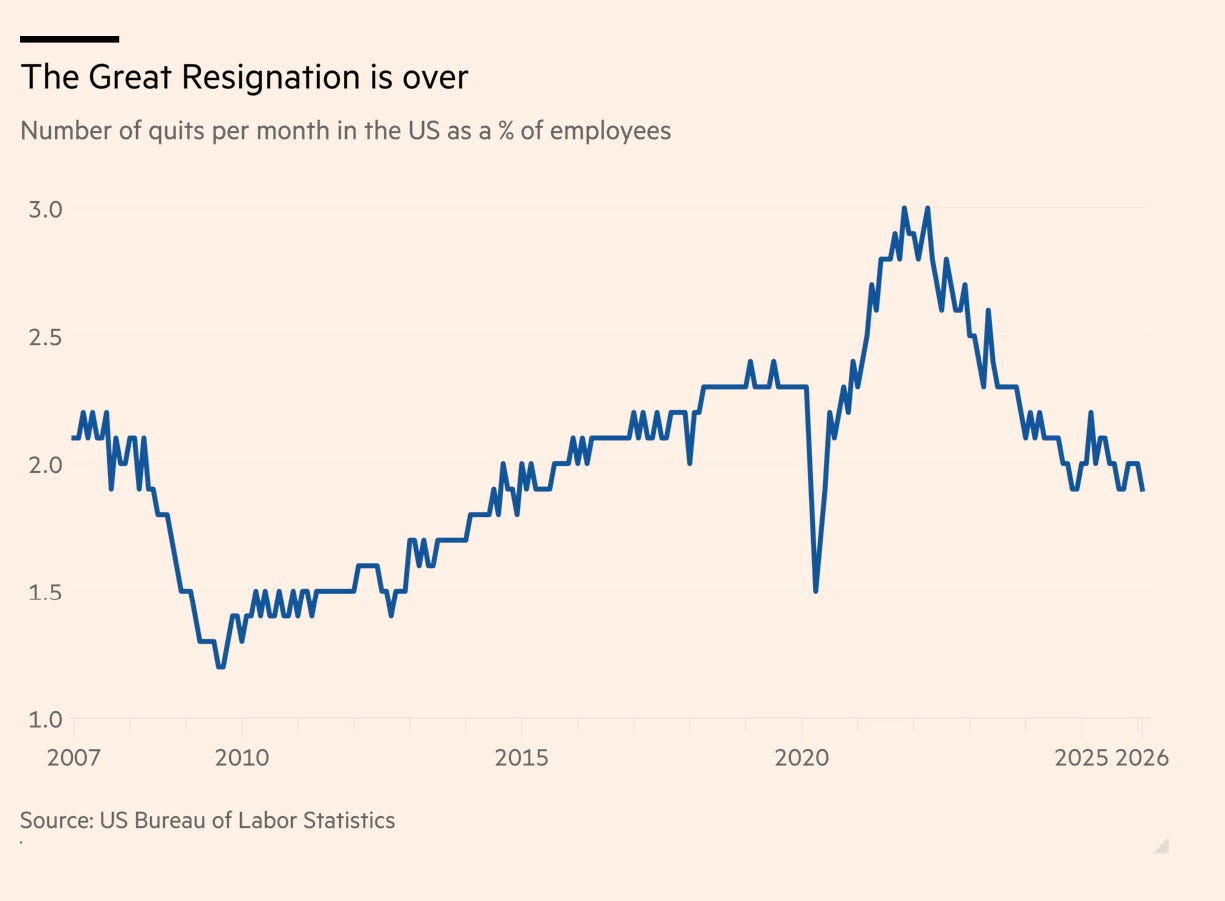
“The last time quit rates were this low…, unemployment was higher than it is now. So why are employees so determined to sit tight? For one thing, there is plenty of macroeconomic uncertainty about, from trade wars to real wars. Regular warnings about looming AI-induced job losses can’t help confidence either. On top of that, the US housing market is weak (though causation might run both ways). I also suspect that some of the people who switched to remote work during the pandemic and moved to rural areas might now be a little trapped in those jobs, without many alternatives that meet their needs.”
“Why Young and Old Men Are Leaving the Labor Force at Record Rates”
While many employees are “hunkering down” at their jobs, The Washington Post reports that “The share of American men working or searching for a job recently hit the lowest level since 1948, aside from the pandemic, Labor Department data shows…[D]ata released Friday showed that 1 in 3 American men were not working or looking for a job in April.”
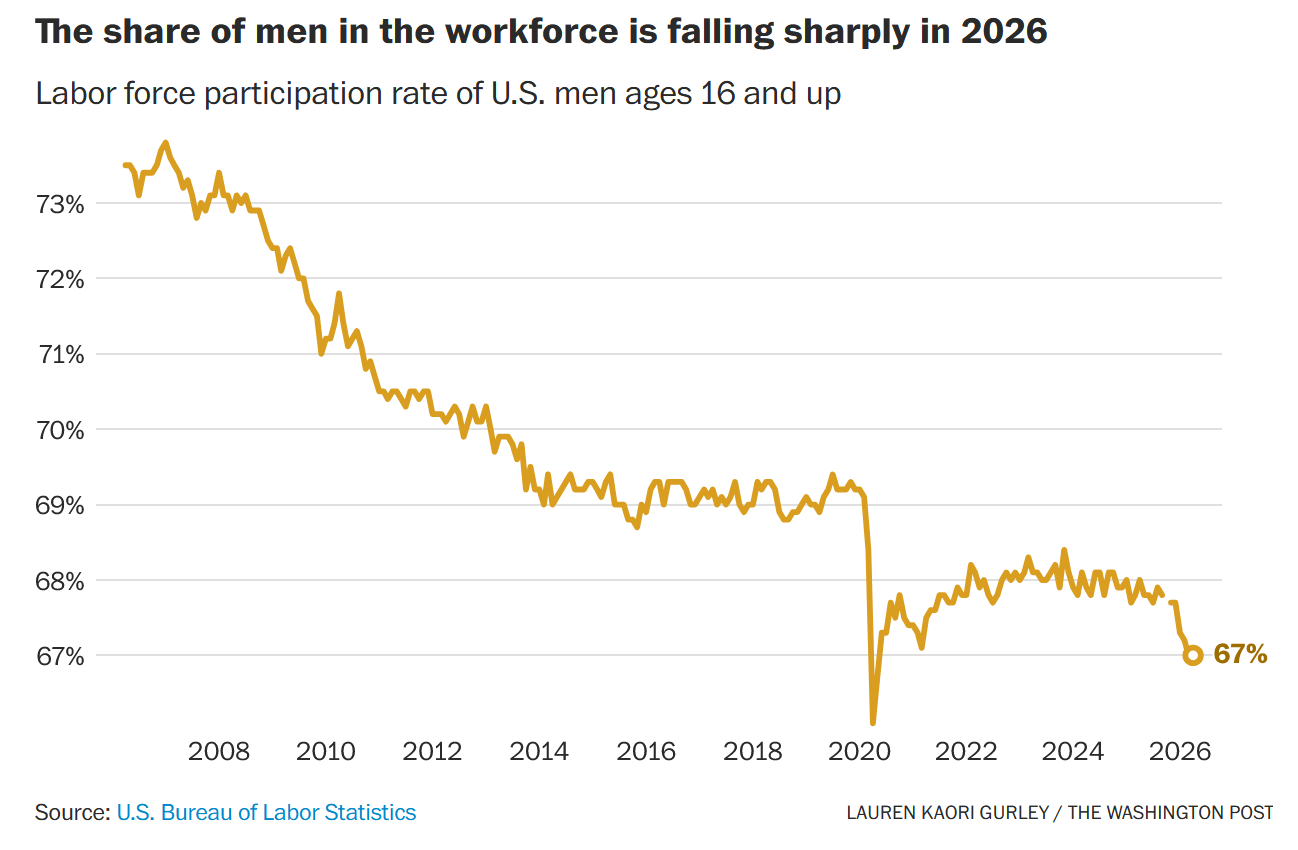
These trends are truly remarkable: “The broader shift toward a service-based economy has…hurt men, economists say. Between January 2025 and March 2026, the U.S. economy created 369,000 jobs—of which 94 percent went to women and 6 percent went to men, an analysis of Bureau of Labor Statistics data by the University of Michigan…shows [my emphasis]. That’s partly because new jobs added to the U.S. economy during that period were in health care or private education. Men often shy away from jobs in those industries because of their lower pay and status, economists say.”
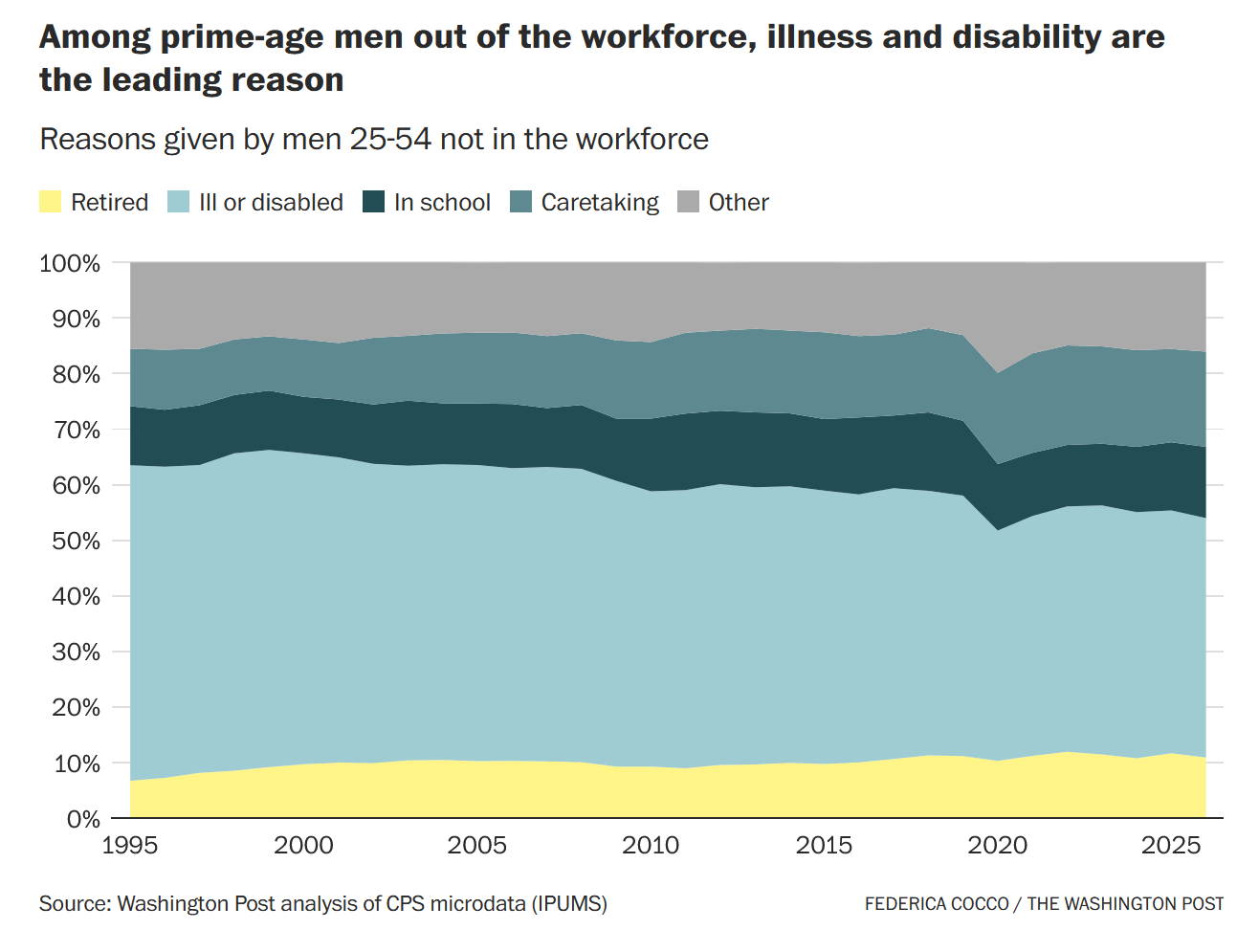
Declining male labor participation is also driven by the chronic illness epidemic in the United States. “Cordell Loll, 25, of Saylorsburg, Pennsylvania, has never worked due to a chronic stomach condition and mental health issues, he said. Instead, he spends his days playing video games and taking care of his health, living off meager monthly disability checks. ‘I have a lot of trouble doing day-to-day stuff sometimes,’ Loll said, ‘so the thought of working seems very impossible.’”
“What the CIA’s ‘Queen of Torture’ Did Next”
In a long-form piece at The New Statesman, Faye Curran tells the disturbing story of retired CIA agent, Alfreda Bikowsky, and the Agency’s War on Terror era torture program: “To the clients of her women’s life coaching business, YBeU Life Coaching, she is Freda Scheuer…For both business and personal reasons, it makes perfect sense for Bikowsky, now 61, to no longer use her birth name. That name and various other pseudonyms she has been known by over the years—Frances (her middle name), deputy chief of Alec Station, or as she was referred to in the New Yorker, the ‘Unidentified Queen of Torture’—carry some weight.”
“As the former deputy and head of Alec Station—a specialised CIA unit that was dedicated to tracking Osama bin Laden and his associates between 1996 and 2005— and later the global jihad unit, Bikowsky has been widely reported to have been among the senior officials associated with the development, implementation and defence of what the CIA described as ‘enhanced interrogation techniques.’ This was a programme of systematic torture of detainees by the CIA, the Defense Intelligence Agency and components of the US Armed Forces at remote sites around the world, authorised by the George W Bush administration. While waterboarding remains the most recognised element of the programme, the ferocity of the torture far exceeded that single technique.”
Curran continues: “As Bikowsky recalls the swelling of transnational jihad before the 9/11 attacks, she maintains that the unit had anticipated an impending strike. ‘We spent the whole summer before 9/11 knowing that a big attack was coming,’ she says. ‘This was not a bolt from the blue. Anyone who says that is misinformed or just not telling the truth. Everyone was expecting something big.’ When something big did happen, it seems to have shifted something inside of Bikowsky. On 11 September itself, she was at CIA headquarters, where all employees were evacuated except her team. ‘I remember being so in awe of my teammates. A lot of them were women… Women were really drawn to this mission,’ she says. After the attack, she was appointed deputy chief of operations at Alec.”
“Bikowsky has never been waterboarded,” Curran notes. “She never considered trying it. When asked about the waterboarding of KSM, and the subject of what constitutes torture, she repeats the same line: ‘In all instances, the agency has never asked me to do anything that I thought was unethical or unlawful or immoral.’…The abrupt lurch from discussing her work as a life coach to the question of her involvement in KSM’s waterboarding seems more uncomfortable for me than it is for her.”
“What Power Is”
At Social Studies, Leighton Woodhouse writes about his reporting trip to Wisconsin: “CS gas, the most common form of tear gas for riot control, was banned from use in warfare by the 1993 Chemical Weapons Convention. But it is routinely used by police against civilians. On April 18, when over 1,000 protesters converged on Ridglan Farms, a dog breeding facility outside of Madison, Wisconsin that sells beagles to laboratories for use in painful and lethal scientific experiments, the 17 law enforcement agencies assembled there to defend the property fired tear gas at crowds of unarmed people continuously and prolifically, for hours. I was there as a reporter, but to my surprise, the drifting clouds of poison did not bother to check my press pass. The powder crawled into my eyes and lungs and alighted on my skin like some ghostly extraterrestrial parasite, just as it did for everyone else.”
“Most of the protesters at Ridglan Farms that day, like most people everywhere, were rule followers” Woodhouse reports. “They were normies. There were plenty of vegans and radicals, but I also interviewed a retired pilot from South Carolina, a retired machinist from Wisconsin, and a welder who served in the military. They told me how much they loved their steaks and how their politics generally leaned rightward. What brought them to the action that day was not ideological fanaticism but the very normal, middle-class moral conviction that abusing puppies for profit was bad. Within minutes of showing up, like me, they were choking on tear gas.”
He concludes: “As Max Weber’s famous definition of the state suggests, the government’s authority is, at its foundation, a function of its capacity to exert violence. In Weber’s formulation, what differentiates the government from criminals is that its exercise of violence is legitimate, by which he means perceived to be legitimate by the broader public. When that government is pulverizing people trying to save puppies, its legitimacy can be cast in doubt, but the violence part is beyond question when you’re choking on it. These are the moments when the scales fall from one’s eyes, when power becomes visible, when the state appears as it actually is rather than what it pretends to be. It’s when you learn what it means to truly disobey.”
“US, EU and China Profoundly Split on AI Intimacy”
At Asia Times, Jan Krikke compares and contrasts Chinese, American, and European approaches to anthropomorphic AI: “Anthropomorphic AI refers to systems that simulate human personality, memory and emotional interaction across text, image, audio, and video. These systems are collapsing the boundary between interface and relationship in ways that regulators are only beginning to confront. The field is expanding faster than the frameworks designed to govern it.”
“China, the EU and the US are not merely regulating software,” he writes. “They are regulating emotional substitution, social fragmentation and technologically mediated intimacy. China builds a regulatory fortress around emotional safety, intervening directly to prevent addiction and social disruption. The state assumes responsibility for the psychological consequences of technologies it permits. The US builds transparency guardrails, trusting informed users to navigate their own relationships. Autonomy is the primary value to protect, with California’s break reminders as a small exception. The EU builds a risk-based framework of general principles, applying existing categories to new phenomena. It leaves considerable ambiguity about how, or whether, AI companions will actually be regulated in practice.”
“These AI systems do not need consciousness to reshape society,” Krikke correctly observes. “They only need to become emotionally credible. Once machines can reliably simulate recognition, empathy, memory and attachment, the question ceases to be technological. It becomes political. Who defines the boundaries of synthetic intimacy? The state? The market? Or the individual user alone? China, Europe and the US answer those questions differently. And these differences may shape the emotional architecture of the AI age itself.”
“The Sacred Triad: Where (and Why) to Draw the AI-mish Line”
At School of the Unconformed, Ruth Gaskovski and Peco write that “if you insist you want to avoid AI only to safeguard ‘what it means to be human,’ then you will be told there is nothing essential about our nature, or that humans are evolving and AI is part of that evolution, and any view to the contrary is backward and short-sighted and maybe even bigoted, and anyway, since China is going to develop it, it’s a foregone conclusion we need to as well, which means opening wide the slop gates and flooding the valleys of our humanity, until we are literally drinking it. Hence Sam Altman calling AI a ‘utility.’ Yes, we are going to drink it.
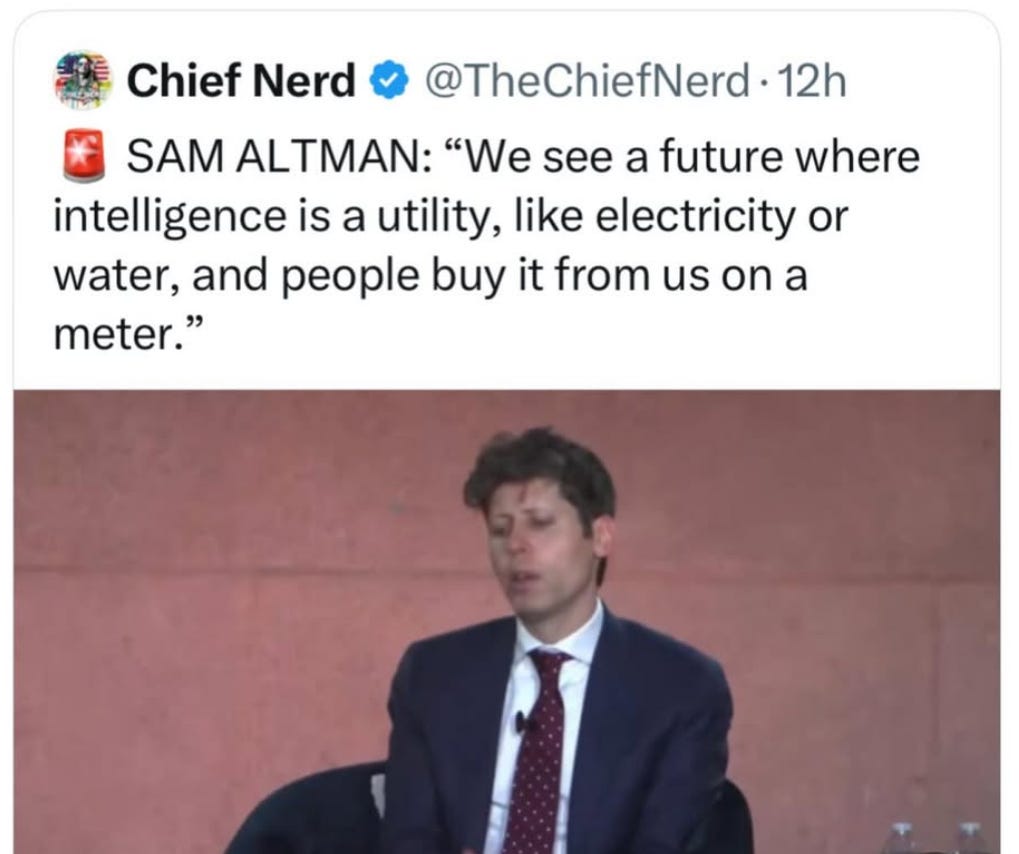
“And once we start drinking it, a heady, intoxicating logic takes over. That spell of inevitability. If it’s smart and knows stuff, why shouldn’t I use it? And look, if I use it as a tool, then it’s okay. AI relieves us of having to make decisions, and in relieving us, it frees us of those difficult and sometimes angst-ridden moments between choices, when we are most likely to become aware of ourselves, our uncertainties and fears, our flaws. And so we keep using it, addicted to the relief of not having to face life on the strength of our own mind, emotions, and spirit, and so we fall prey to Kierkegaard’s warning, that we lose ourselves very quietly, as if it were nothing at all. AI will never tell you, ‘That’s enough, you go do it yourself.’ AI has no in-built braking mechanism to stop you from over-relying on AI.”
The authors continue: “A 2025 Common Sense report found that 72% of teens have used AI companions, and 52% are regular users, and a stunning 32% find AI interactions equally or more satisfying than human conversations. No wonder. AI affirms, flatters, and ‘empathizes’ at ubermensch levels, something many teenagers desperately long for. Using AI chatbots as ersatz companions is becoming popular, but in her summary of a research article on negative implications of sycophantic AI, Luiza Jarovsky, PhD points out that relational distortions set in swiftly: ‘Even a single interaction with sycophantic AI reduced participants’ willingness to take responsibility and repair interpersonal conflicts, while increasing their own conviction that they were right.’”
What grounded your thinking this week? Share in the comments.