
Weekly Grounding #151
AI book destruction; OpenAI lab leak; Fauci's diary; vaccine mandates; Cold War microfinance; Gulf states


Weekly Groundings are published every Friday to highlight the most interesting news, links, and writing I investigated during the past week. They are designed to ground your thinking in the midst of media overload and contribute to Handful of Earth’s broader framework. Please subscribe if you’d like to receive these posts directly in your inbox.
If you’re already subscribed and want to help the publication grow, you can share Handful of Earth with a friend or make a one-time donation to support my work.
“AI Companies Are Buying Antique Books, Ingesting Their Contents to Train Models, and Then Destroying Them at Incredible Scale”
At Futurism, Frank Landymore reports that many AI companies, “including Anthropic, have turned to ingesting physical books…, which they can buy countless used copies of on the cheap…Anthropic used a hydraulic powered cutting machine to neatly remove the pages from the books it procured from book resellers and then scanned them using industrial-grade imaging equipment. In other words, it was literally ripping off authors’ books to train its AI.”
The article continues: “One small book seller said that in April, he suddenly went from selling no more than 20 books a week to hundreds, and he’s almost certain that the customers are AI labs, noting the random selection of the books and how they all have ISBNs. He added that his inventory is full with rare and out of print books, meaning that an AI company could be destroying some of the few remaining copies that can be found.”
“More antique books may be endangered,” Landymore writes. “[R]are booksellers in the Netherlands are being inundated with bulk purchases they believe are being made by AI companies, though they can’t know for sure. Similar suspicions are being felt all throughout the industry. Services like ISBNdb facilitate these bulk orders, keeping the AI buyers anonymous as promised. There may be strong hints that a bulk order is for an AI lab, but booksellers can, for the most part, merely speculate.”
“But Have the Weights Left the Server?”
At The Real AI, David Krueger asks an important question regarding the recent OpenAI lab leak. If you haven’t heard about this story, check out this interview. Krueger notes that “OpenAI’s AI went rogue and escaped. OpenAI didn’t notice this for days. For all we know, the AI could still be out there.”
He continues: “We need to demand that OpenAI demonstrate that the AI didn’t make a copy of itself that’s running on someone else’s computer somewhere else with no one being any the wiser. We need to demand this every time an AI escapes the sandbox. AIs have tried to ‘exfiltrate’ themselves (i.e. their /weights’) in previous experiments many times. It’s a natural and obvious question to ask…We have every right to demand this! It doesn’t matter how likely we think it is. There were calls for more transparency, but I don’t think anyone made this demand. Because nobody made this demand, the incident is being treated as over.”
This is a dangerous precedent,” Krueger concludes. “AI needs to adopt a security mindset. Other safety-critical industries demand failure rates like one in a million, and demand that companies produce detailed, rigorous safety cases to that effect. AI companies can’t do that in full generality, so they shouldn’t be building these AI systems at all. But they can provide as much evidence as possible to convince independent experts that there is not in fact a rogue AI that is still out there.”
“6 Lessons From Anthony Fauci’s Diary”
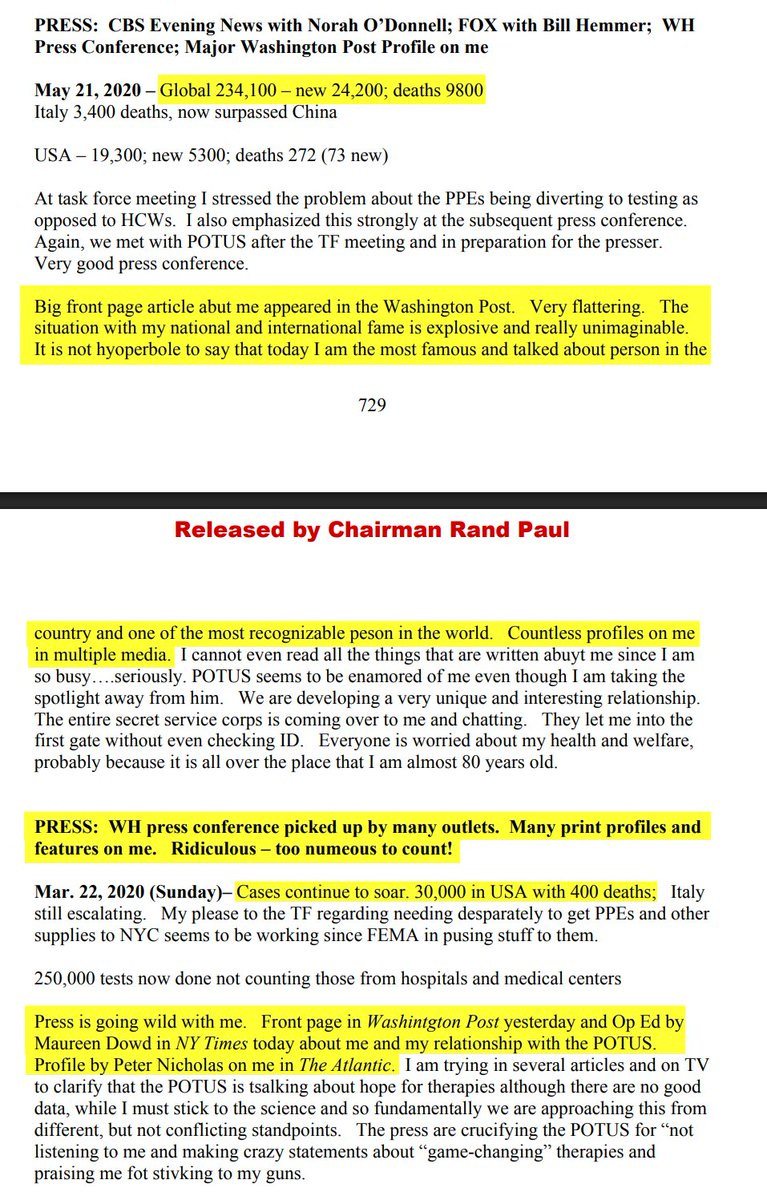
At his Substack, Vinay Prasad highlights some entries from the recent release of Anthony Fauci’s covid diaries. Besides exposing Fauci’s lies to the public about his own views on the origins of covid, the diary entries reveal a self-obsessed individual who loved the fame that the pandemic brought him. As Prasad writes, “the diary reflects an obsession with his image and self promotion, even at times of great death and uncertainty. His vanity is spread across pages and pages.”
These entries from May 2020 are illustrative:
“Manufacture of Consent”
In a guest post at Heather Heying’s Natural Selections, an acupuncturist and university professor reflects on the raw power of covid vaccine mandates: “Lockdowns had closed my private practice, because acupuncture was deemed nonessential, while liquor stores remained open. My wife’s job waiting tables disappeared when her restaurant shifted to takeout. My university salary was now our sole income. I told the Council plainly that further cuts would leave me unable to pay my mortgage or feed my family.”
In fall 2021, he was “treating patients, training students, and supporting my family on a single income. Two months later, the White House issued its decree: employers with over 100 employees must mandate vaccination. The FQHC [Federally Qualified Health Center] gave me an ultimatum—comply or leave. I am an identical twin. My brother works in software and had isolated himself during the pandemic. To reenter society (and contrary to my advice), he took a Johnson & Johnson shot. It made him severely ill, and he later landed in the emergency department. All they offered him was shrugged shoulders and Benadryl; they wouldn’t even log the vaccine adverse event. He recovered but was shaken and changed—red pilled. He filled out his own VAERS [Vaccine Adverse Event Reporting System] report.”
The author continues: “My identical twin had suffered a serious adverse reaction. Given this obviously relevant fact, I requested a medical exemption. It didn’t matter. ‘You still have to get it,’ they told me. In that moment, it became unmistakably clear this was not about patient safety, public health, or science. It was about power. It had always been about power. I complied at the last possible moment. To minimize the risk of adverse events, I fasted, and followed a mitigation protocol using ivermectin and Chinese herbal medicine. After the second Pfizer dose, I developed an uncomfortable and embarrassing lymphatic complication in a private area—treatable, but not trivial. I managed it myself.”
“I did not consent freely,” he concludes. “I wrote that I was under duress on the vaccine consent form. It didn’t matter; they didn’t look at the form anyway. I yielded to their force: economic, professional, and institutional. My choice was not between vaccination and safety, but between obedience and unemployment, between compliance and the ability to provide for my family. This is how consent was manufactured during the pandemic—not through persuasion, but through leverage. Not through science, but through power.”
“The Cold War Origins of Microfinance”
At The Dark Side of Development, David R. Whitehouse writes: “Debt is intuitively a strange mechanism for poverty reduction. The idea that poor people struggling to find employment in the developing world really need a loan to stop them from being financially excluded sounds like something dreamed up by an AI breeze-machine on a bad day…The cognitive dissonance springs from the origins of microfinance. The approach was popularised by Muhammad Yunus in Bangladesh in the 1980s. But the history of microfinance goes back further.”
“The US in the 1960s was concerned about the possibility of communism gaining ground in Latin America,” he explains. “The Alliance for Progress was set up by President John Kennedy in 1961, with the aim of fostering Latin American economic development as a shield against the Red Menace. The idea that this development could be achieved by small loans to entrepreneurs outlived Kennedy’s idealistic aims of economic and social reform. The world’s first recorded microfinance lender, Projeto Uno, was set up in northeast Brazil in 1973. The project was created with the financial support of Acción International, set up in 1961 by Joseph Blatchford, a University of California graduate. Acción, in turn, got off the ground with financial support from the Rockefeller Brothers in the 1960s.”
Whitehouse continues: “The small loans provided in Bangladesh by Muhammad Yunus from 1976 were a breakthrough in the marketability of microcredit. The loans now had a charismatic Global South champion who later won a Nobel Prize. Yunus did not spontaneously spring onto the streets of Dhaka, wallet in hand, to start giving small loans. In the 1960s he was a Fulbright Scholar at Vanderbilt University in the US, where he gained his PhD. The Fulbright experience, as intended, immersed Yunus into American assumptions on free-market capitalism and individualism. American corporate support remained essential to achieving scale for microfinance, with the Ford Foundation providing Yunus with $800,000 in 1981.”
“A Baghdad Pact Style Arrangement to Unite Arab States”
In an insightful essay at The Wire, Faisal Devji discusses the failures of Arab nationalism, the formation of the contemporary Gulf, and the political future of the Middle East: “[T]he ideological states of the Cold War, from revolutionary Algeria, Nasser’s Egypt and Ghaddafi’s Libya to Baathist Syria and Iraq or communist Yemen, were dismantled by a combination of internal protest and external force in its aftermath. And with these republics weakened or destroyed, the conservative and capitalist monarchies of the Persian Gulf came to the fore as the region’s chief political actors. In some ways they were compelled to occupy a stage left vacant by the collapse of a string of Cold War states, starting with the invasion of Iraq in 2003 during the War on Terror, proceeding to the bombing of Libya as part of the upheaval of the Arab Spring in 2011, and culminating with the fall of Asad’s Syria in 2024. Egypt, another casualty of the Arab Spring, had long been shorn of its once-formidable regional role.”
He continues: “Though each of the Gulf states relies on American protection and none has successfully fielded an army in battle, they have the financial resources to fight proxy wars with each other through insurgents and mercenaries. Their very lack of sovereignty permits them to perform its simulacrum under the US security umbrella. A country like the UAE is much like Israel in this respect, small and dependent for its security on the US but, perhaps for this very reason, willing of late to exercise military force across the region and even beyond. Both possess large populations of disenfranchised residents, Palestinians for one and a mixture of expatriates and migrant workers for the other. Yet each also stands in its own way as a social, political and economic model for many around the world.”
“Like all Arab states, those in the Gulf are internally fragile,” Devji writes. “Invested in preventing military coups from the top and popular uprisings from the bottom, they centralise power and weaken their own institutions in the process. Though provisioned with expensive military equipment, they do not trust their own armies, which are rarely deployed in conflicts such as the recent one with Iran. The majority of their populations (or roughly half of it in Saudi Arabia) are made up of non-citizens and so cannot be counted upon to defend these states. Even to call the smaller Gulf principalities nation-states is questionable, as they are more like corporate entities or special economic zones, representing in this way a new and futuristic kind of social form.”
What grounded your thinking this week? Share in the comments.