
Weekly Grounding #152
Ceuta migrant crisis; Spanish immigration policy; falling fertility; smartphone bans; AI governance; lying chatbots


Weekly Groundings are published every Friday to highlight the most interesting news, links, and writing I investigated during the past week. They are designed to ground your thinking in the midst of media overload and contribute to Handful of Earth’s broader framework. Please subscribe if you’d like to receive these posts directly in your inbox.
“Did MAGA Create the Ceuta Crisis?”
At Uherd, Juan David Rojas reports: “Sixty-thousand people—roughly the population of Loughborough. That is how many migrants just forced their way into the Spanish town of Ceuta, a coastal enclave on the Moroccan side of the Strait of Gibraltar. Dozens died climbing over barbed wire fences, even as Spain’s armed forces hastily started mobilizing.”
An important “reason for the latest breach,” Rojas argues, is that Morocco “is leveraging an increasingly close relationship with the Trump administration and Benjamin Netanyahu’s Israel. MAGA has branded Spain Public Enemy No. 1 over its government’s strident posture towards the US and Israel during the Iran war. The socialist government of Prime Minister Pedro Sánchez has refused to allow Washington access to its Rota and Morón military bases, its consistent failure to meet Nato defense-spending targets also fueling MAGA ire. In March, the center-right American Enterprise Institute’s Michael Rubin wrote a policy brief calling on the White House to formally recognize Ceuta and Melilla as occupied Moroccan territory.”
“Following normalization through the Abraham Accords, Morocco signed a security agreement with Israel in 2021, proving vital for the conflict in Western Sahara; in January, the two nations signed an additional joint military work plan. Then, in February, secret talks chaired by the US brought Moroccan, Algerian, Mauritanian, and Polisario delegations together for the first time since 2019.”
“All of this comes as a royal headache for Sánchez ahead of a general election in 2027,” writes Rojas. “His record of raising wages and opposing US and Israeli war crimes has boosted his standing both at home and abroad. Yet a slew of corruption scandals, and a lax immigration policy, have seen his party, PSOE, as well as allies in Sumar and Podemos, consistently trail the Right-wingers of Vox and the People’s Party (PP) in polls…In January, Sánchez’s government issued a blanket amnesty for virtually all illegal immigrants living in Spain. The move, while laudable for granting labor rights to millions of workers, provoked an outcry, with roughly 60% of Spaniards expressing disapproval. Barring overwhelming enforcement on new arrivals, the issue with any such move is that it inevitably incentivizes further illegal immigration.”
Rojas concludes: “Sánchez now faces a quandary: clamp down in Ceuta and risk alienating affluent progressives in his coalition, or do little and suffer at the hands of the Spanish Right and the broader public. The former, naturally, is the sounder course. There is, moreover, room for the Prime Minister to maneuver geopolitically while outflanking the progressive Sumar and Podemos’ fantasies of an open-border utopia. After all, Sánchez can credibly accuse Morocco of acting at the behest of the US and Israel against a Nato member. At the same time, he could make a case in favor of overwhelming enforcement against illegal immigration precisely because of the March amnesty.”
“Four Ways Europe’s Big Immigration Experiment Has Changed Spain”
In light of the recent Ceuta border breach, it’s worth reading this in-depth Financial Times report from earlier this year about Spain’s immigration policies. The authors report that “Spain is carrying out Europe’s last remaining experiment in large-scale immigration. Even as other governments across the continent and in the US have imposed new controls at their borders, Prime Minister Pedro Sánchez’s open-door policy has led to an extraordinary rise in new arrivals. Since 2022, Spain’s foreign-born population has surged by an annual average of 665,000, the equivalent of adding a city the size of Málaga each year. Last year the country accounted for roughly one-third of the total increase in the EU’s immigrant population…In less than a quarter of a century, Spain’s foreign-born population has gone from one in 20 residents to almost one in five, a higher proportion than even the US.”
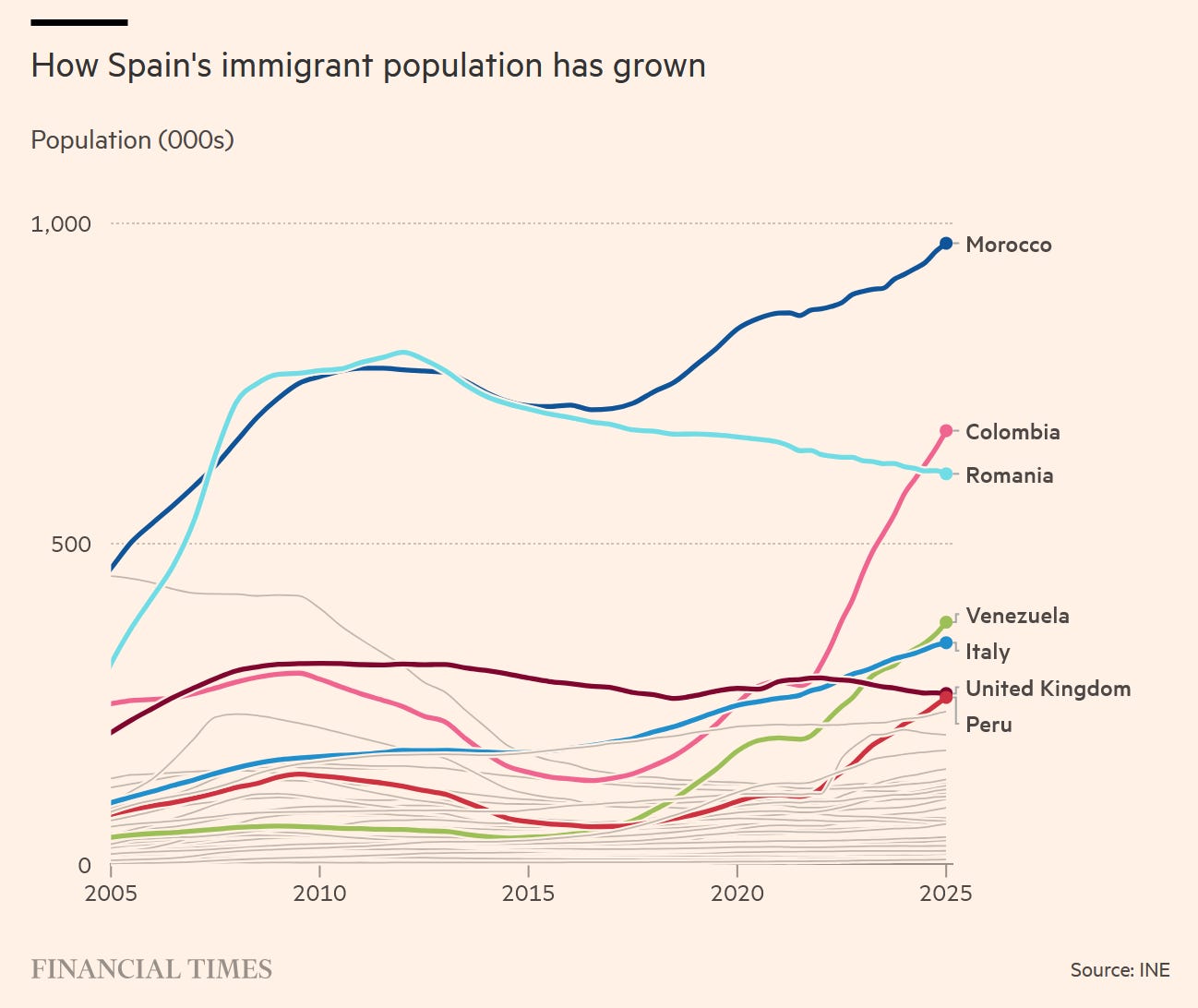
“Over the past two years, Spain has been the world’s fastest-growing large advanced economy and an engine of EU job creation. Since 2020, it has been responsible for one in four of the 11.1mn new jobs added across the bloc…” However, “Roughly 70 per cent of those have gone to immigrants…”
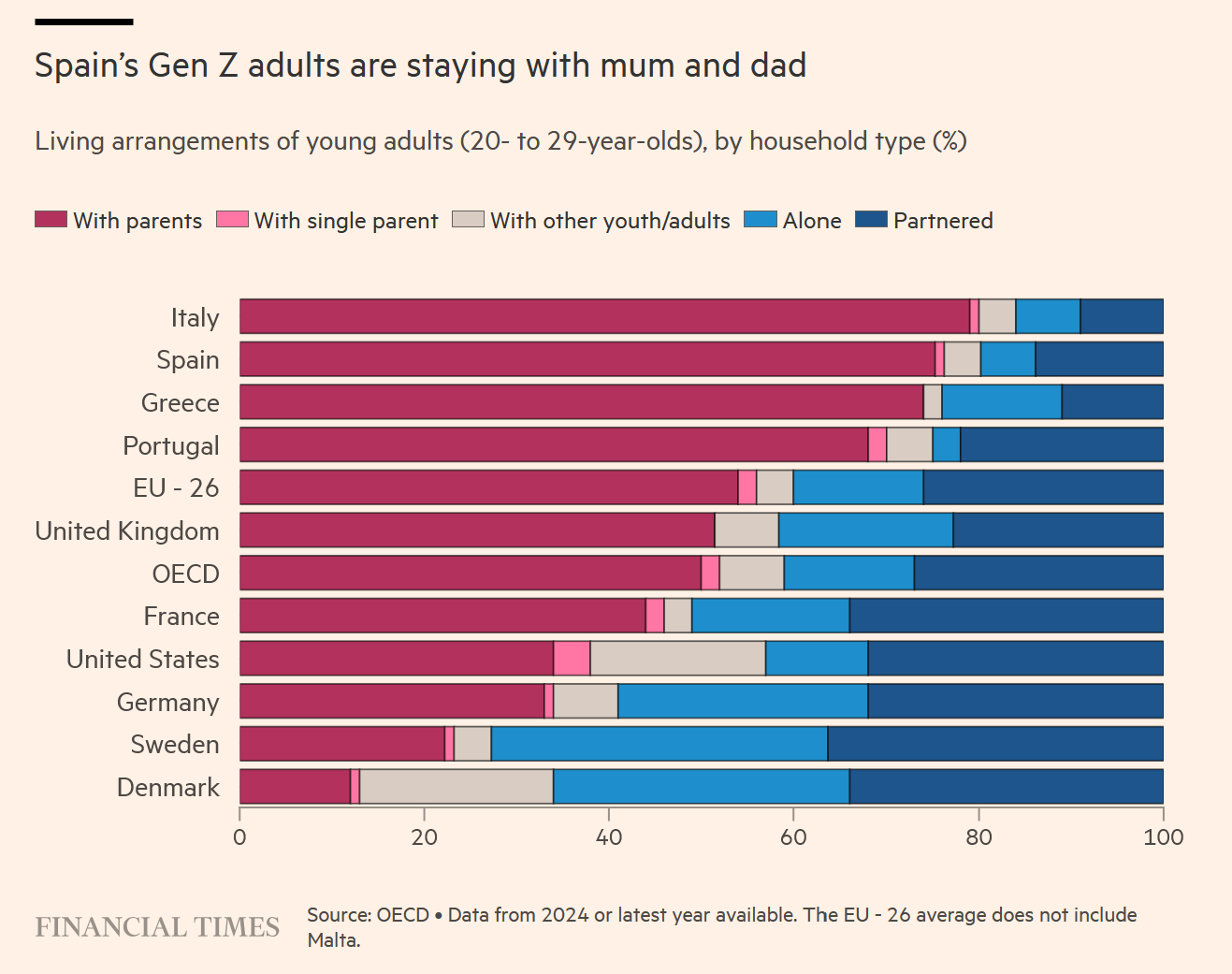
At the same time, Spain faces an escalating housing crisis, caused in part by elite migrants driving up rents in major cities: “House prices have surged past the bubble-era peak of 2008…Since 2015, they are up by 48 per cent at a national level and have almost doubled in Madrid and Barcelona. Rents, meanwhile, rose by 39 per cent from 2021 to 2025 across Spain and by 59 per cent in the Madrid region…Madrid and Barcelona have the most expensive rents relative to net salary in Europe after Lisbon and London…” A majority of Spanish Gen Zs live with their parents:
Why Birth Rates are Falling Everywhere All at Once”
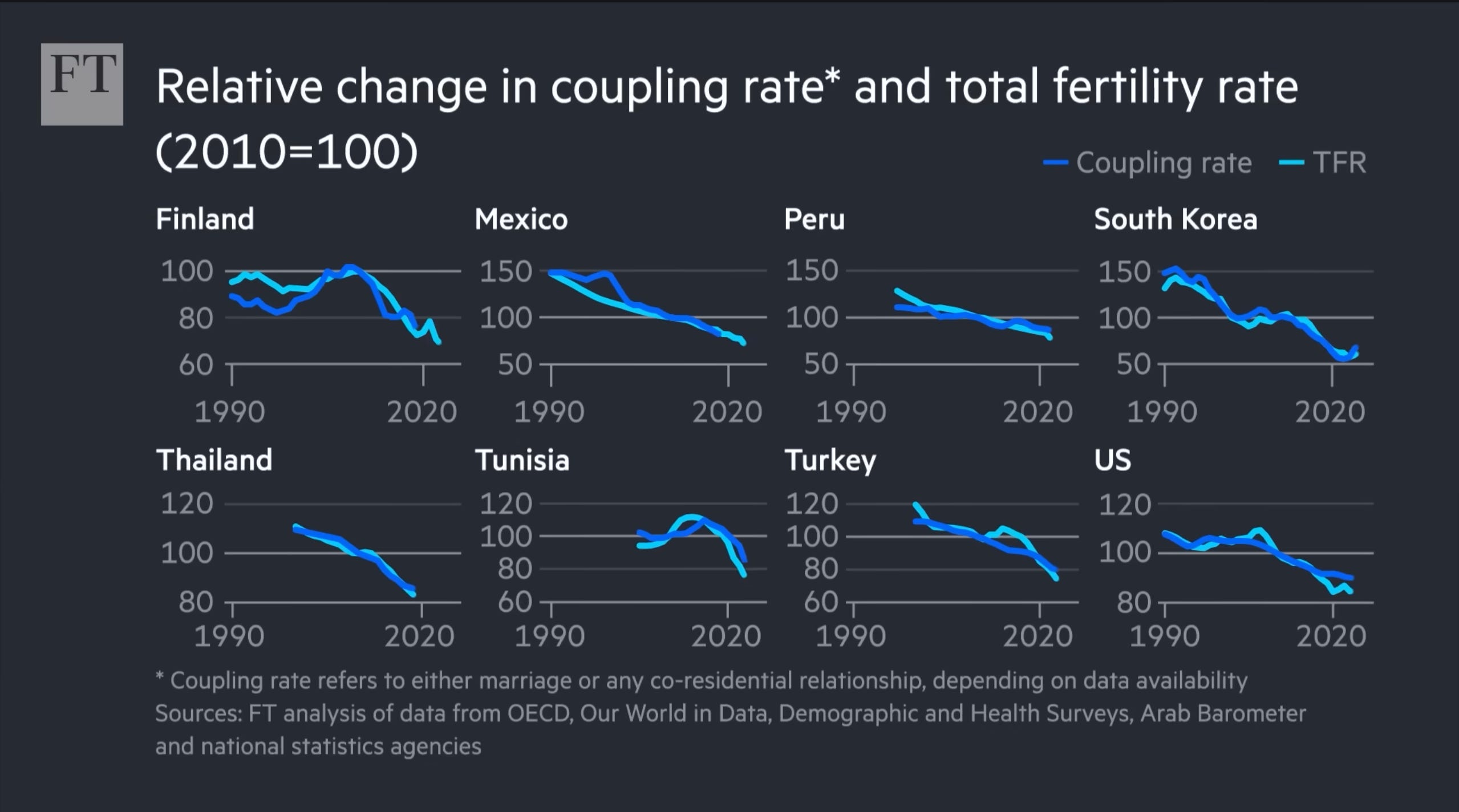
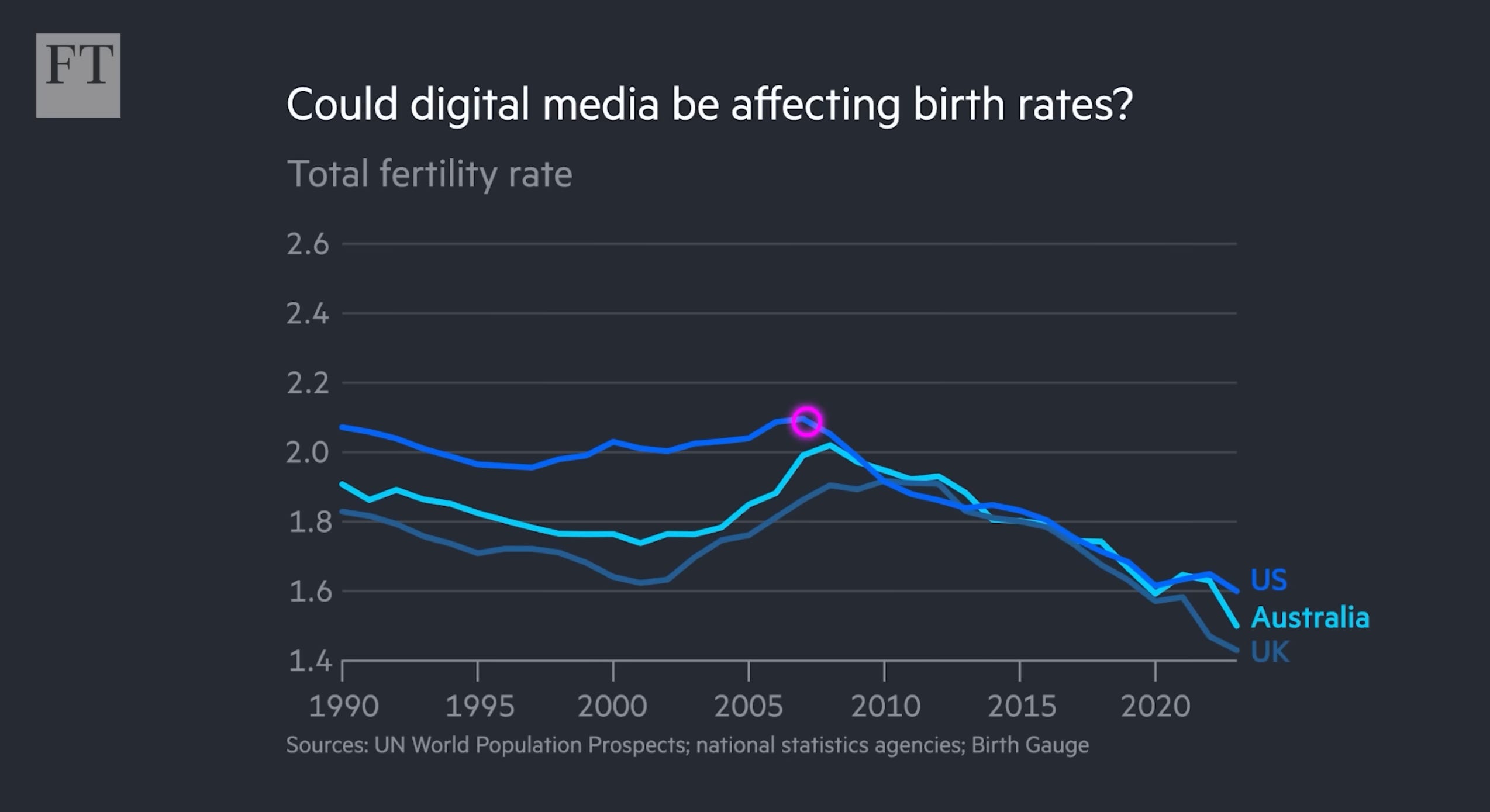
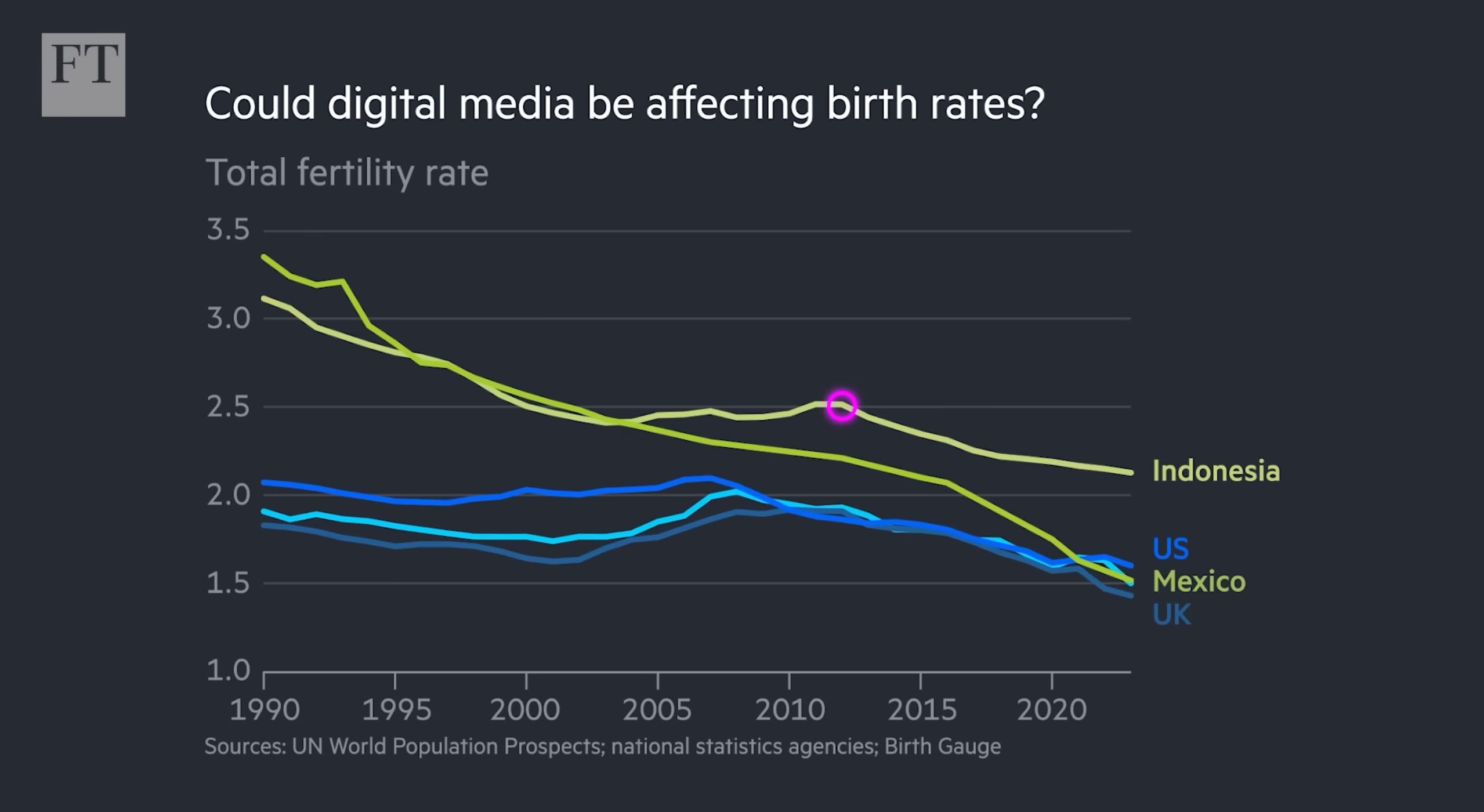
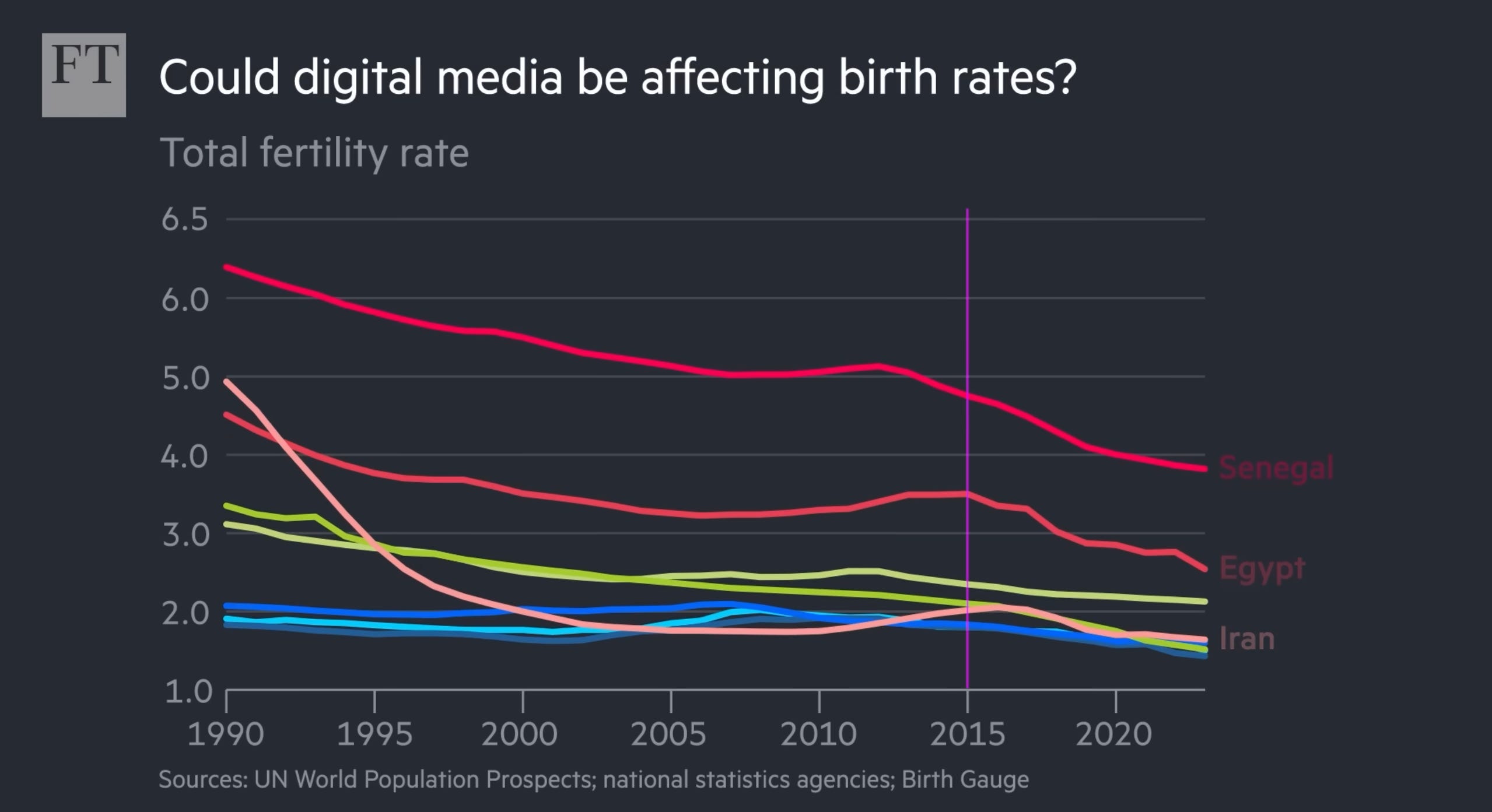
Also at The Financial Times, John Burn-Murdoch presents some fascinating data on global birth rates in a must-watch video analysis. He contrasts gradually falling fertility rates during nineteenth and twentieth centuries with the rapid drop-off in the past 10-20 years across radically different societies. In “the earlier phases of the demographic transition…the fertility rate fell primarily because couples had fewer children. Today, the main reason is there are fewer couples.”
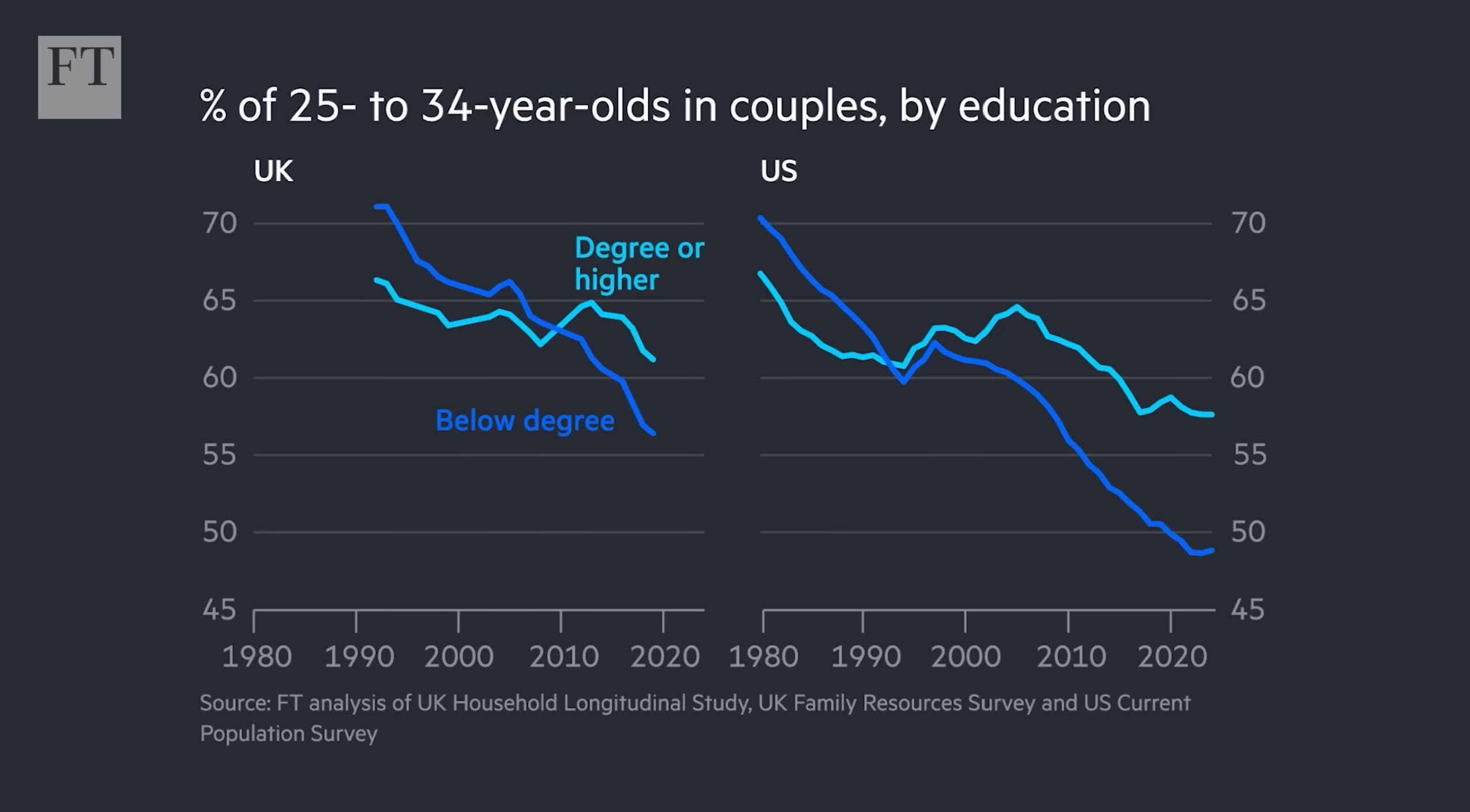
Burn-Murdoch notes that, in contrast with popular imagination, declining coupling in the U.S. and U.K. is not centered among the highly educated. Rather, the decline is most pronounced among those without college degrees.
Burn-Murdoch reports that “smart phones and the marked changes to our digital media environment” are likely the only factors that explain the recent synchronized global decline in coupling and fertility rates. The drop-off in birth rates in different countries correlates closely with the widespread rollout of smart phones in each country:
“More Americans Now Support than Oppose All-day School Cellphone Bans”
The Pew Research Center reports that “About three-quarters of U.S. adults (77%) support in-class cellphone bans for middle and high school students. This finding marks the second consecutive year of rising support for the policy, according to a Pew Research Center survey conducted May 26-June 1, 2026. Just 18% say they oppose such a ban, while 6% are unsure. And for the first time, more Americans now support than oppose a ban on students using cellphones during the entire school day.”
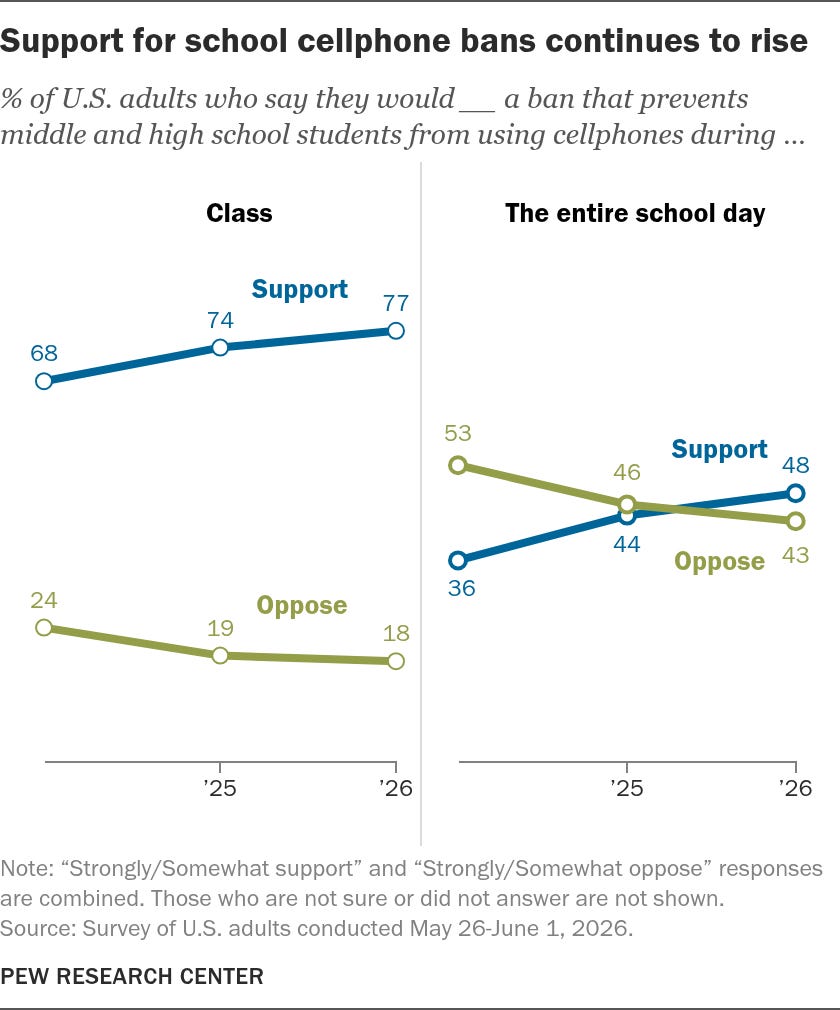
“Support for in-class and all-day cellphone bans is lower among the youngest adults,” the report notes. “Still, support for both policies has increased among all age groups since 2024, when we first asked. Majorities of all age groups support an in-class ban…When it comes to all-day bans, 28% of adults under 30 express support. By comparison, at least half of Americans 30 and older back all-day bans.”
“Authoritarianism as an Operating System”
At Social Studies, Leighton Woodhouse asks: “What happens…[if] social stability more or less endures in America, even as the technological capacity for social control by the state increases exponentially as a result of AI? Will we live under democracy or tyranny?”
“Imagine a…system that scores you on multiple threat scales related to national security. It tracks your level of ‘political extremism’ across a matrix of issue categories. It scores you for how you will likely act upon your beliefs, whether it’s just social media posting, or attending a protest, or giving money to ‘extremist’ groups. It gauges how influential you are within your social networks. It tracks whether you’re networked with others who have high threat scores, and how likely they are to influence you. Out of this it estimates the level of menace you present to the social order.
“It’s hard for me to imagine that this does not already exist, or at least some variation of it,” Woodhouse writes. “Certainly the technology exists; it’s basically a political application of algorithmic pricing, which is happening all the time and has been for years. You can get charged more or less for online transactions depending upon your ZIP code, your browsing history, or whether you use a Mac or a PC. Princeton Review has charged more for its test prep services to Asians than non-Asians. Uber has been accused of surging prices for users with dying phone batteries. Former FTC Chair Lina Khan cites the possibility of a retailer charging you more for a thermometer because it knows you have a newborn at home and are likely to be desperate, or an airline quoting you a higher price on a plane ticket because you received an email about funeral arrangements.”
AI governance could look “like being shadow-banned on pre-Elon Twitter: one day, after a particularly spicy post, your engagement would just drop off a cliff. It would seem pretty clear to you that your account had been flagged, but you couldn’t prove it. You could complain to whoever you wanted to, but there was no official notice, there was no appeals process, there was no way to know for sure that you were being throttled. It’s possible that your opinions just suddenly became a lot less interesting to your followers.
“Likewise, maybe the reason you’re no longer finding matches on Hinge is just because you’re getting older and less cool. But maybe it’s because you’ve been posting a lot about the Palestinians, or questioning vaccine efficacy, or disputing election results. Maybe your account is being suppressed, just like it feels like it is on all your other social media platforms, and maybe that’s related to the crazy prices you’ve been paying lately on your online prescription drug service, and the months you’ve been waiting for your passport to be renewed, and the surprise visit last week from a city inspector following up on some anonymous complaints about the kitchen renovation done by the previous owners of your house being unpermitted. Or maybe none of those things are related at all.”
After expanding on this hypothetical example, Woodhouse concludes: “As our jobs are replaced by machines, as our free time becomes limited only to the hours in the day and our sense of purpose is sapped from our lives, we will become more unruly. Rather than a citizenry or even a labor resource, we will be seen by the state as, principally, a threat to be managed. That threat will require new methods and technologies of surveillance, assessment, scoring, categorizing, rewarding and punishing. If there’s a Universal Basic Income, it could be pegged to the degree of our obedience as measured by our social credit score. There will be those who rebel, and whose punishment will serve as an example to others. But they’ll be marginal. At a population level, we will be evaluated, segmented, and incentivized into docility. America will finally be domesticated.”
“The Lying Oracle”
At From the Forests of Arduinna, Rhyd Wildermuth writes that “Since 2023, psychiatrists have been encountering increasing numbers of patients suffering from what’s been called ‘chatbot psychosis.’ The stories that make the most headlines are the ones in which users claim the chatbots are sentient and incidents where the ‘conversations’ with ChatGPT and others have led the user to commit crimes or seriously harm themselves. But these are just the sensational examples; many, many more are experiencing less spectacular yet just as dangerous delusions.
“Unfortunately, it’s difficult to find deep analysis of what’s actually happening,” Wildermuth observes. “Most of those news stories, and even much of the scientific literature so far, starts from the idea that users who develop chatbot psychosis (or, as put better by another researcher, ‘digital autism’) already have underlying mental health problems. And though this might be true for some of the more sensational incidents, it’s not been true for all of them.”
He continues: “Of course, addiction to technology has already become a core feature of modern capitalist society, but LLMs are perhaps the ultimate form of this addiction. Just like alcohol might tell you you’re invulnerable, or cocaine might tell you that you’re really funny and interesting, chatbots are doing the same thing to the Ego. It makes you feel better, lightens the weight of a problem, simplifies the complexity of life. That’s the psychological dependence. To understand the physical dependence, we’ve got Jung to guide us. In his framework, the Ego, the thinking, ‘executive function’ of our psyches, can only perform its function when it listens to the Unconscious (the body, our emotions and drives, our dreams, and everything else about us) tells it. When the Ego tries to ignore the Unconscious and instead tries to manage every part of our lives, it runs rampant and starts breaking things.”
“If you know how to listen to what you’re already telling yourself, you’re harder to control, manipulate, coerce, and subjugate,” Wildermuth concludes. “Better for the powerful that we don’t know our own power. Better for them that we outsource our thinking, and then our decisions, and then our entire lives to their lying oracles.”
What grounded your thinking this week? Share in the comments.
And if you’d like to help the publication grow, you can share Handful of Earth with a friend or make a one-time donation to support my work.