
Weekly Grounding #150
Forever wars; political typologies; Platner campaign; media trials; Marco Rubio; Mahmoud Khalil


Today’s Weekly Grounding is the 150th published at Handful of Earth! I started writing these over three years ago in 2023 and, here we are now, one hundred and fifty installments later. Handful of Earth’s growth has been slow but steady and Weekly Groundings are a core part of the publication. If you appreciate this aspect of Handful of Earth and want to see it grow, share my work with a friend today.
Everything is free to read on Handful of Earth right now, but it takes a lot of work to put these Groundings together each week. I am not on social media and I never use AI, so the curation process is more old school (i.e. labor-intensive) than most of the content you find online these days. If you want to help support this process, you can make a one-time donation to Handful of Earth by clicking on the button below. I very much appreciate any amount you are able to give.
If you are new here, Weekly Groundings are published every Friday to highlight the most interesting news, links, and writing I investigated during the past week. They are designed to ground your thinking in the midst of media overload and contribute to Handful of Earth’s broader framework. Please subscribe if you’d like to receive these posts directly in your inbox.
Without further ado, here’s Weekly Grounding #150.
“Iran Is Turning Into the Sort of ‘Forever War’ that Donald Trump Promised to Avoid”
At The Conversation, Bamo Nouri and Inderjeet Parmar write that “When Donald Trump returned to the White House, he promised to avoid another Middle Eastern ‘forever war.’ After the costly experiences of Iraq and Afghanistan, that pledge resonated with an American public weary of prolonged military intervention.” However, in Iran, “Washington continues to combine military pressure with calls for renewed negotiations. But rather than representing the collapse of an isolated peace initiative, these developments may confirm the reality of grey zone conflict—where diplomacy manages war rather than ends it.”
They note that “The confrontation with Iran is fundamentally different” from American wars in Iraq and Afghanistan. “It is unlikely to require occupation of territory and no serious or sustained attempt directly to remake the Iranian state. Instead, it is fought through air strikes, cyber operations, sanctions, maritime confrontation, intelligence activity and proxy warfare. Military escalation is followed by diplomacy, diplomacy gives way to renewed confrontation, and each episode is presented as a separate crisis.”
“Much of the debate focuses on whether the latest escalation will produce a wider regional war,” Nouri and Parmar observe. “That possibility cannot be dismissed. Yet another scenario may be equally, if not more, plausible. The US and Iran are settling into a prolonged cycle of calibrated confrontation that lasts far longer than many currently anticipate. Trump promised to end America’s forever wars. Ironically, his presidency may instead come to symbolise the evolution of a new kind of forever war without a clearly defined beginning or end. The greatest danger may therefore not be another Iraq. It may be the gradual normalisation of an enduring conflict that repeatedly disappears from the headlines, only to return in new forms because the political conditions necessary for genuine peace have yet to emerge.”
“Beyond Red vs. Blue: The Political Typology”
Pew Research states that “beneath that familiar red-blue partisan divide is a much more nuanced picture: Many Americans hold a complex mix of values and beliefs that don’t always fit neatly into either major party. Pew Research Center’s new political typology shows how this complexity plays out, sorting the public into nine distinct groups based on their political and cultural values, not their party. The result is a picture of American politics with far more than two colors in it.”
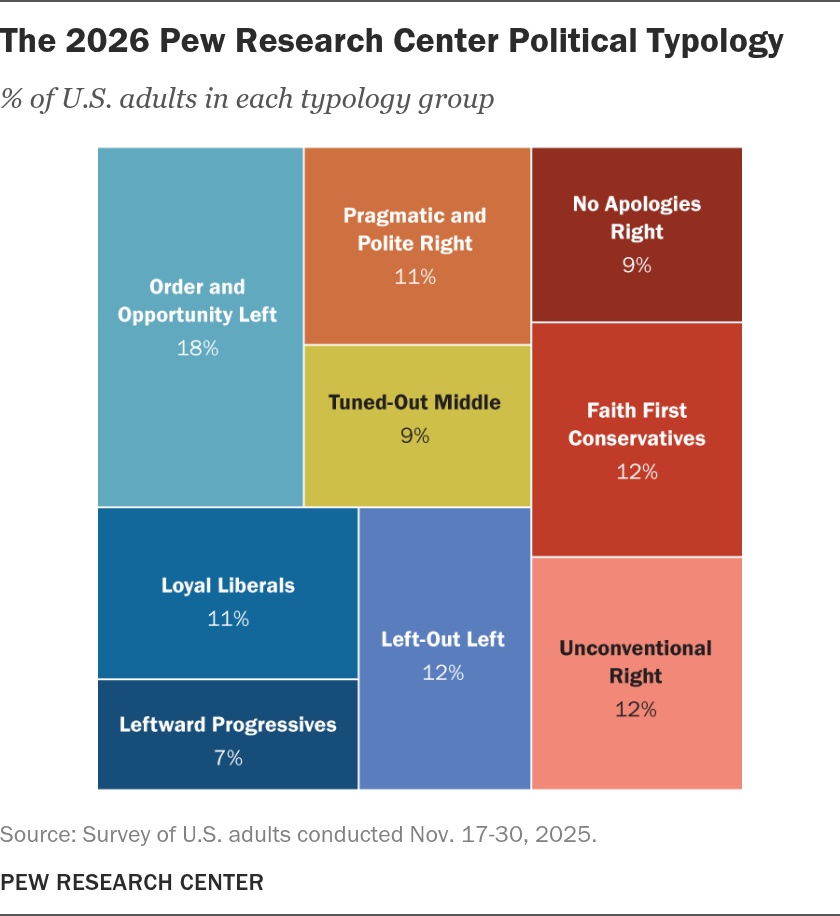
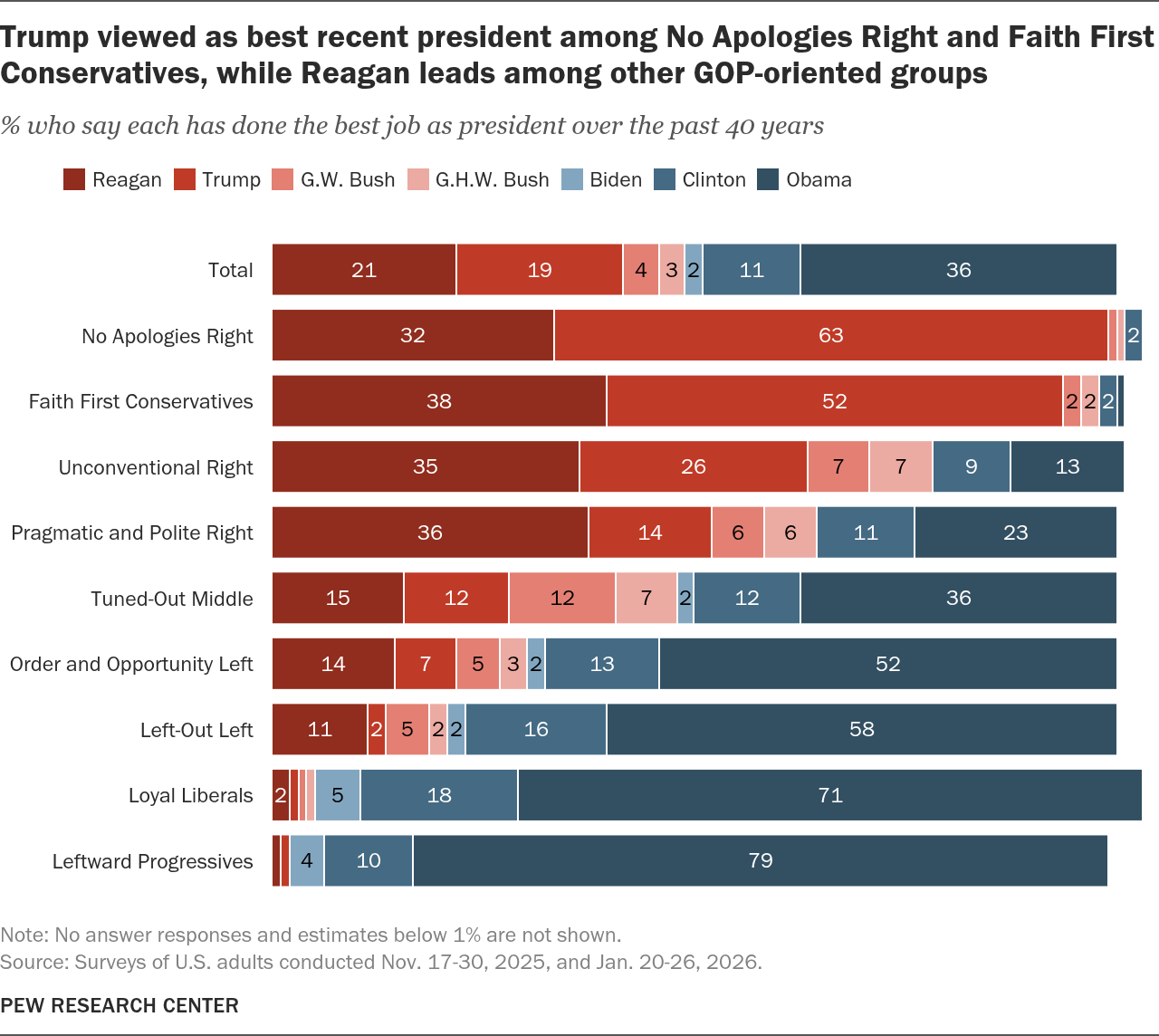
“The 2026 political typology is the ninth in a series dating back to 1987. This year’s typology groups are based on a survey of 10,357 U.S. adults conducted Nov. 17-30, 2025. The analysis in this report also draws on several additional surveys conducted with these same respondents from January 2025 through April 2026.” Opinions of the various groups on recent presidents are worth highlighting:
For another take on American political personality types, see my essay, “Does This Political Category Exist?”
“Platner’s Guru Daniel Moraff Asked Me to Lie for Him (I Didn’t)”
Mike Elk recounts a personal story about Graham Platner’s handler, Daniel Moraff, at Payday Report: “Moraff told me he was recruiting Bryan Pietzrak, a General Electric locomotive factory worker and UE member, to run for Congress in Erie. He said he wanted Pietrzak to run as an independent. While researching Pietrzak, Moraff found anti-Trump quotes he had given Payday and asked me to delete them. In October of 2020, Pietrzak spoke at a Biden rally at Carrie Furnaces in Rankin, PA, where he blasted Trump at length. ‘No union member should vote for Trump,’ Pietzrak told Payday Report in October of 2020.”
He continues: “Moraff explained at length that Pietzrak’s quote against Trump could hurt his chances of appealing to Trump voters in Erie. I told him deleting a quote as a political favor would violate journalistic ethics. He insisted I do it even after I said no. Cajoling me, Moraff told me that, ‘No one would know that I deleted the quote.’ I told him that wasn’t the issue, and that it was unethical, so I refused. He told me to forget the conversation and never mention it to anyone. It’s important to know Moraff asked me to lie for a candidate he was recruiting.”
“Given what happened with Platner, I think the incident with Moraff asking me to lie is important,” Elk reflects. “If Moraff felt comfortable asking me, someone that he didn’t know that well, to lie, it means that he possibly got influencers and journalists in the past to lie on his behalf. When I heard that Moraff was involved in vetting and recruiting Platner, I recalled this experience. It showed me that Moraff was willing to lie to get someone elected and to ask journalists to do unethical things to help sell those lies. Sadly, in the age of influencers and content creators, many former journalists would be willing to engage in the kind of lying that someone like Moraff requested. I would not.”
For an analysis of Platner and Moraff, see my article, “The Populism-Industrial Complex.”
“Believe Women and the Presumption of Guilt in Media Trials”
While I have argued strongly against the politics represented by Platner and his handlers, the response to sexual assault accusations against him is concerning for a number of reasons. At her Substack, Jenin Younes notes that “Within minutes of the…publication [of the accusations], prominent figures in the Democratic party called for Platner’s resignation, along with a chorus of liberal and left identifying individuals on social media. Though Platner denied the allegation, he caved to the pressure a long three days later, withdrawing from the race.”
Younes makes a number of important points including the following about Platner’s accuser, Jennifer Racicot: “The trouble here is that none of the texts, social media messages or emails that Racicot wrote and produced to Politico were contemporaneous, or close to it, with the event in question…Racicot’s social media messages about Platner to her friend were written in 2023, about a year and a half after the incident. Additionally, the messages did not directly accuse Platner of sexual assault; rather, Racicot described Platner as ‘consensually careless,’ a phrase which could mean many things and does not equate to a simultaneous allegation of sexual assault. This is the type of issue that would be the subject of cross-examination at a courtroom trial, but since this is a more-or-less one-sided media adjudication, there is no such opportunity for elucidating what Racicot meant by that phrase.”
She concludes: “Platner’s campaign has ended, and his political career is likely over. But this issue goes beyond Platner. Despite the multitude of sexual harassment and assault claims against prominent figures, often accompanied by successful demands their political or professional demise (though not always—think Pete Hegseth, Bill Clinton, and Corey [sic] Mills), we have not actually determined how to address and grapple with claims of sexual harassment and assault outside of a trial.
“As many have rightly pointed out, the fact there are no charges or conviction here does not make Racicot’s accusation immaterial to most voters. But at the same time, a society committed both to accountability and to fairness cannot simply replace the presumption of innocence that governs the legal context with a presumption of guilt at media trials.”
“Secretary Rubio Delivers Opening Remarks at the Ministerial on the Resurgence of Political Terrorism”
In a chilling speech, Secretary of State, Marco Rubio, calls for ramped-up repression of political dissent, directed at a new central enemy: “extremist violence from the political left.” Rubio states that “For these architects of revolutionary violence, the towering achievement of our civilization—for them it’s an unbearable humiliation, a reminder of what they cannot do and a reminder of what they cannot be. So they choose instead to destroy. They attack pipelines; they attack railroads; they attack power grids and laboratories, the physical embodied symbols of power and invention and achievement. This is the nature of the terrorism we face today. They despise the West because the West is great.”
Invoking a neo-Nietzschean argument, Rubio calls the left “a distinctive and unique evil. It has always been driven by a hatred above all else, a hatred for civilization itself. It is a revolt of the worst against the best, a revolt of the weak and the cowardly against the strong and the good. It is perpetrated by those who cannot build, who cannot create, who cannot achieve great things, and take their revenge upon the world for their own inadequacy by seeking to destroy those who can. This is what radical leftism is. It may wear various different slogans and ideologies across place and time. They can call themselves anti-capitalist or anti-imperialist or communist or anarchist or Marxist. But the fundamental character is always the same. It’s always the same.
Rubio advocates for a coordinated international surveillance and repression campaign “Through intelligence and information sharing, through coordinated law enforcement strategy, through financial targeting and disruption” to “dismantle” leftist “networks brick by brick.”
“Mahmoud Khalil Accuses Trump Officials of Conspiring Against Him”
Meanwhile, The New York Times reports that “Mahmoud Khalil, the Columbia University protester who became the face of President Trump’s campus crackdown, filed a lawsuit…accusing administration officials, pro-Israel groups and a conservative think tank of colluding to suppress his constitutional rights.”
“The suit, filed in Manhattan federal court, yokes together a number of different actors: the Heritage Foundation, several top Trump officials and two groups that targeted campus protesters, Canary Mission and Betar. Mr. Khalil will seek to convince a judge that the defendants coordinated to a degree that amounted to a conspiracy. His lawyers argue that there was a direct line leading from a Heritage Foundation plan to dismantle pro-Palestinian activism to the targeting of activists, like Mr. Khalil, by Canary Mission and Betar, which led to their arrests and detention by the Trump administration.”
“Mr. Khalil’s lawsuit is being brought under a statute enacted in 1871 to obstruct the activities of the Ku Klux Klan,” the Times reports. “The law prevents any person from conspiring to deprive a person of protection under the law. Mr. Khalil is asking for monetary damages in an amount to be determined at a civil trial and for a judge to declare that efforts to deport him are part of a conspiracy. The law requires those suing to ‘provide some factual basis supporting a meeting of the minds, such that defendants entered into an agreement, express or tacit, to achieve the unlawful end.’ That basis can be circumstantial, as is often the case in Mr. Khalil’s lawsuit. It will be up to a Manhattan judge to determine whether the lawsuit meets the standard that would require the government to produce more information.”
What grounded your thinking this week? Share in the comments.
That best president graph is illuminating. Looks like there is broad agreement that no one liked Biden.